

The Dignity and Cross of Motherhood
Adam was formed first, then Eve; and Adam was not deceived, but the woman was deceived and became a transgressor. Yet she will be saved through childbearing—if they continue in faith and love and holiness, with self-control.
1 Timothy 2:13-15
The passage above contains an odd promise of sorts. It’s about motherhood. In the broader context, St. Paul addresses expectations for men, women, and ordained leaders in the church, but he includes this striking line along the way. At first blush, the verse might seem condescending or derogatory. But as we will see in a moment, that is not at all the case.
As an aside, I should note that I am decidedly not a mother. Still, I hope to be a husband, father, and priest who celebrates and believes in motherhood. What would I be without my mother? Where would my family be without the work of my wife? What is our society without mothers or God’s Church without her mothers? As Christians, we believe in the goodness of motherhood and that God blesses it in itself. Nothing needs to be added for women to be “enough.” Although God may call mothers to many tasks in and out of the home, motherhood needs no qualifications or additions.
Sponsored
This is because motherhood is a vocation from God (just as fatherhood is). “Vocation” comes from the Latin vocatio, a “call” or “summons”—one of the places in life where God calls out. In motherhood, God calls the woman (and the world around her) and works powerfully in and through her. And that’s so powerful, because I think the reader will recognize that, even if they do not always directly attack it, large chunks of our culture marginalize motherhood.
The Dignity of Motherhood
The Promise in Motherhood
In context, Paul links this teaching in 1 Timothy 2:13-15 about women in the church with Eve’s deception and transgression in the garden. So is he saying women must do this to be saved? Of course not. Genesis 3 speaks of Eve herself being saved through her descendant—through childbirth, through Jesus the Christ. Paul takes us back to God’s promise in Genesis that he would save humanity through the birth of a child. This is, itself, the Protoevangelium or “First Gospel” in the Bible:
The Lord God said to the serpent…
Genesis 3:14-15
“I will put enmity between you and the woman,
and between your offspring and her offspring;
he shall bruise your head,
and you shall bruise his heel.”
On this side of Jesus’ person and work, every birth now reminds us of the Savior who came through woman. The one deceived in the Fall is now crowned with this particular glory: woman, through Mary the Virgin, is made the Mother of God. And so we read:
And she gave birth to her firstborn son and wrapped him in swaddling cloths and laid him in a manger. … And at the end of eight days, when he was circumcised, he was called Jesus, the name given by the angel before he was conceived in the womb.
Luke 2:7, 21
Back to 1 Timothy 2:15. In their book Family Vocation, father and daughter team Gene Veith and Mary Moerbe write this:
Paul…applies the promise to our mother Eve to all mothers. Eve’s childbearing leads to the birth of Christ. All childbearing is thus a sign of the gospel… Everyone with the vocation of mother… manifests the incarnation of God. Now, every childbirth can remind us of that first Christmas, that holy birth that elevates every other birth.
Gene Edward Veith Jr. & Mary J. Moerbe, Family Vocation, 135
We find the promise of the Gospel in all motherhood.
The Sanctity of Motherhood
Next, motherhood is sacred – and God says as much in his Word. In Luke 2:22, we read that “when the time came for their purification according to the Law of Moses, [Joseph and Mary] brought [Jesus] up to Jerusalem to present him to the Lord.”
When Mary enters the Temple courts at the Presentation of Jesus, not only is she presenting her son to the Lord in a special and unique way, but she is also fulfilling the ritual laws regarding purification after childbirth.
We find the basis for this in Leviticus 12:3-4:
On the eighth day [after birth], the flesh of the boy’s foreskin shall be circumcised, and then she [the mother] shall spend thirty-three days more in a state of blood purity; she shall not touch anything sacred nor enter the sanctuary till the days of her purification are fulfilled.
Leviticus 12:3-4
Let us not misunderstand the Law of Moses here and chalk this up to some demeaning “patriarchy.” As author Scott Hahn argues,
This does not mean that the law considered … womanhood or childbirth to be “dirty” or sinful. No, just as the priest had to purify the holy vessels every time they were used in the Temple liturgy … so a woman who gave birth also had to be purified following the holy use of her sacred body.
Scott Hahn, Joy to the World,132-133
That’s especially compelling when you consider the One Mary bore in her womb.
The Prayer Book tradition reflects this same biblically grounded impulse to dignify motherhood and give thanks for it. The 2019 Book of Common Prayer includes a liturgy for the Thanksgiving for the Birth or Adoption of a Child. This liturgy springs from The Churching of Women, included in the first prayer book and later developed in The 1662 Book of Common Prayer. The rite begins with this exhortation:
Forasmuch as it hath pleased almighty God of his goodness to give you safe deliverance, and to preserve you in the great danger of childbirth, you shall therefore give hearty thanks to God.
The 1662 Book of Common Prayer International Edition, IVP, 349
Motherhood is compelling, dignified, and a thing filled to the brim with thanksgiving. Motherhood is holy.
The Cross of Motherhood
The Sorrow in the “Yes” of Motherhood
Mary, that icon of motherhood, gave God an unconditional “yes”: “Behold the handmaid of the Lord; be it unto me according to thy word” (Luke 1:38, KJV). Through childbirth, she pictures perfect faith. She asks, “How will this be?”—not, “How can this be?” Beyond that, she believes. In other words, she trusts God completely.
Other mothers have said “yes,” too: yes to the beauty of their calling, and yes to the cross and sorrow that often follow in ways they could never predict.
To return to 1 Timothy 2:15: “Yet [women] will be saved through childbearing—if they continue in faith and love and holiness, with self-control.” To Christian mothers, I can say this with certainty: God works out your salvation with fear and trembling through your vocation of motherhood (Philippians 2:12-13). And all the mothers say, “Amen.”
The Roman Catholic devotion to Mary (or, if you prefer, to God’s work in Mary) called The Seven Sorrows traces how God’s calling brought sorrow into her life. Simeon prophesied this sorrow directly at Jesus’ Presentation:
And Simeon blessed them and said to Mary his mother, “Behold, this child is appointed for the fall and rising of many in Israel, and for a sign that is opposed (and a sword will pierce through your own soul also), so that thoughts from many hearts may be revealed.”
Luke 2:34-35
For Mary, this piercing sword included false shame imposed by others (the unspoken, “Oh, we all know good and well how that baby was brought into the world!”), the anxiety and weight of caring for the Messiah (like when she and Joseph lost Jesus, then found him in the Temple), and finally witnessing the crucifixion and death of her son.
While we do not believe Mary is in any way a Co-redemptrix of the world (even the Roman Catholic Church has recently reined that language in), we do affirm that her sorrows in connection with Jesus belonged to her carrying her cross as she walked with the Savior through this life, from the womb to the tomb.
This is true of all motherhood. It includes sorrow; sorrow belongs to the cross; and at the cross—blessed truth—we come into intimate communion with Jesus.
The Sacrifice of Motherhood
Alongside the sorrow, there is a particular sacrifice in motherhood as well. There is the famous quote from The Cost of Discipleship by the German martyr and pastor Dietrich Bonhoeffer: “When Christ calls a man, he bids him come and die.” Well, when Christ calls a woman to motherhood, he bids her come and die. And all the mothers say, “Amen.”
Again, from Moerbe and Veith:
Yes, motherhood is full of great joys and satisfactions. But we should not minimize the difficulties. And mothers should certainly not feel guilty when the pains seem to exceed the joys, as if they were bad mothers just because they are not always happy when dealing with their children. Motherhood is a solemn vocation of the greatest importance, and all vocations bring with their own trials and tribulations. But the sufferings of mothers have another dimension. … [M]otherhood is a sign of the gospel. Motherhood also is an enactment of the gospel; that is, mothers suffer sacrifice themselves to create and sustain new life.
Gene Edward Veith Jr. & Mary J. Moerbe, Family Vocation, 139-140
In this, God is calling the woman from who she was, into who she will become. We can say this of mothers in a way that isn’t exactly true of fathers. Isn’t it true that the Christian mother has poured herself out at the feet of the Lord? Once a woman becomes a mother, she cannot return to who she was. Physically, emotionally, and spiritually, motherhood brings irrevocable change. Motherhood is a kind of death, so that a different kind of life may emerge. And for Christian mothers, it brings them into closer fellowship with that Death and Resurrection which is our life and salvation.
So it is that motherhood contains and shows forth the promises of the Gospel. Motherhood is holy and adorned as such by God in his Word. It is a cross of sorrows. It is a sacrifice made for others in communion with Christ.
For all this and more, we give all the thanks, praise, and honor to God the Father, God the Son, and God the Holy Spirit. Amen.
Image: photo by Anneke Schram from anyka, courtesy of Canva. Digitally edited by Jacob Davis.

A Deeper Devotion at the Cross
Nothing is more essential to the Christian life than what we make of Jesus’ cross. As we grow in Christ, we do not move on to other, higher planes; rather, our perception of the cross deepens. Our fellowship with our crucified Messiah grows more intimate. The cross grows ever more beautiful in our eyes the longer we linger.
Praise for At the Cross
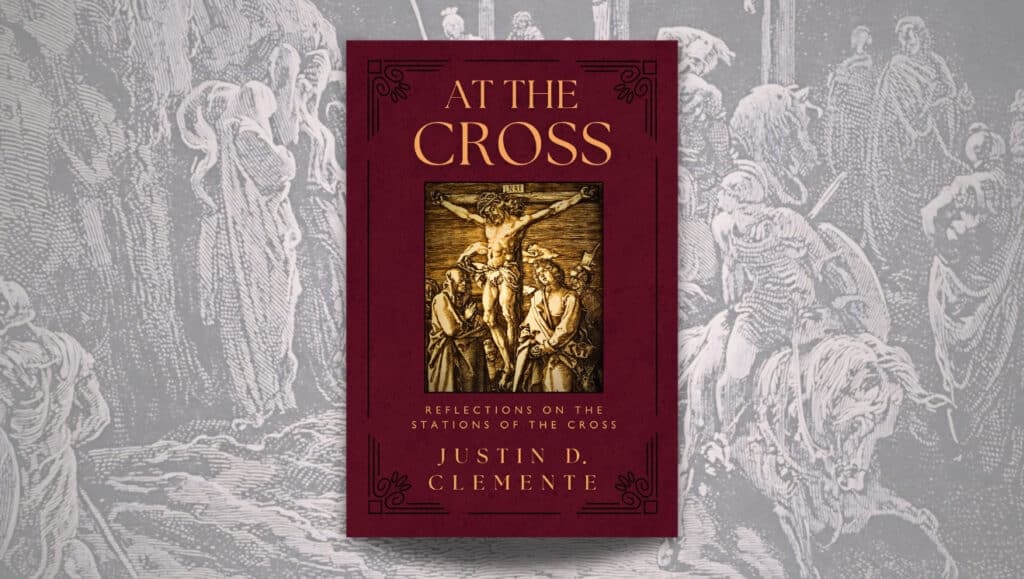
Anglican Compass announces the release of Justin Clemente’s “At the Cross: Reflections on the Stations of the Cross,” available on Amazon. This book offers insightful reflections on the Biblical Stations, drawing from various theologians and artists, enhancing understanding of Christ’s Passion, and is suitable for individual or group devotion throughout the year.
