

St. Ignatius of Antioch: Apostolic Father and Martyr
It’s the first decade of the second century AD. Roman soldiers have arrived, and they want blood. The so-called “atheists” of Antioch continue to stir up controversy, refusing to worship the Roman gods. Amid the persecuted stands one who claims to bear Christ in his breast. His aim is simple: to attain God through suffering like Jesus.
This is the likely situation in which Ignatius, the Bishop of Antioch, found himself in chains (see the Martyrdom of Ignatius). Amid persecution in Antioch, this pastor, believed to be a disciple of the Apostle John, willingly submitted to chains so he might die for giving a defense of the Gospel before the rulers of this world.

Sponsored
On his way from Syria to Rome, where he expected wild beasts in the Colosseum to devour him, Ignatius penned seven letters. Six went to churches in Asia Minor and one to a fellow bishop, Polycarp. In these letters we find the beating heart of the early Church: a people united under their bishops, thereby united to Christ, and willing to suffer for the Gospel.
Unity Under the Bishop
One central feature of Ignatius’ epistles is his insistence on the Church’s ministers. Where Clement of Rome’s epistle to the Church in Corinth seems to name only two orders, bishops and deacons, Ignatius insists upon three: bishops, presbyters (priests), and deacons. More than this, he denies the Church’s existence apart from these ministers:
Let all reverence the deacons as an appointment of Jesus Christ, and the bishop as Jesus Christ, who is the Son of the Father, and the presbyters as the Sanhedrin of God, and assembly of the apostles. Apart from these, there is no Church.
Ignatius, Epistle to the Trallians, chapter 3
Perhaps you’ve noticed some strong language? Can we not conceive of the Church apart from her ministers? Herein we see an echo of the Johannine promise that if we have fellowship with the Apostles (and their successors), we have fellowship with God (1 John 1:1-3). While the ministers are not the fullness of the Church, they are essential to her vitality and maturity (Eph 4:11-16).
What of his language about reverence for the bishop? This is not an anomaly. Ignatius writes elsewhere, “We should look upon the bishop even as we would upon the Lord himself” (Ign. Eph. 6). Is Ignatius trying to puff himself and other bishops up? He refuses such notions, saying,
I do not issue orders to you, as if I were some great person. For though I am bound for the name [of Christ], I am not yet perfect in Jesus Christ. For now I begin to be a disciple, and I speak to you as fellow disciples with me.
Ignatius, Epistle to the Ephesians, chapter 3
The Bishop as Sign, Not Rival
Why then such strong language concerning how one ought to reverence the bishop? As Archbishop Michael Ramsey observed,
[T]he Bishop does not have a greatness of his own; he is the organ of the one Body, and to the local Church its dependence within the historic family, whose worship is one act. Just as the Apostles had represented these truths, so now to S. Ignatius and the other Bishops.
Michael Ramsey, The Gospel and the Catholic Church, 80
Unity at the Table
Ignatius did not simply expect honor toward the bishop; he saw the episcopacy as God’s gift to the Church for her unity. While we often question authority, Ignatius spoke to a generation whose leaders were arrested, beaten, injured, and killed for the Gospel. He recognized that these churches faced oppression from Rome, confusion from heretics, and internal division born of fear. In response, he urges them to remain united under the bishop’s godly headship. This unity appears not only in words, but in the Eucharistic life of the Church:
Take heed, then, to have but one Eucharist. For there is one flesh of our Lord Jesus Christ, one cup to [show forth] the unity of his blood; one altar; as there is one bishop, along with the presbytery and deacons, my fellow-servants: that so, whatsoever you do, you may do it according to the will of God.
Ignatius, Epistle to the Philippians, chapter 4
Christ Is the Church
Ignatius’ insistence on unity under the bishop was not a pragmatic response to persecution, but an apostolic outworking of the sacramental union between Christ and the Church. Many readers may be surprised by how easily Ignatius moves between Christology and Ecclesiology. While we tend to distinguish our doctrine of Christ from our doctrine of the Church, Ignatius reflects the biblical witness that Christ and the Church may not be separated. Before the cleansing of the Last Judgment, the visible church remains mixed with wheat and tares (Matt 13:24-30, 26-43), yet the invisible union between Christ and his Church remains. Our Lord taught the same to St. Paul, asking the oppressor of the Church, “Saul, Saul, why are you persecuting me?” (Acts 26:14). The apostle later confessed the Church to be “his body, the fullness of him who fills all in all” (Eph 1:23).
Ministry as Christ’s Visible Care
The Bishop of Antioch sees the ministry of the bishop, priests, and deacons as a visible demonstration of Christ’s life. The bishop is not a bare emblem, but a tangible assurance of the one who walks among the lampstands (Rev. 2:1). Where the Docetists denied the incarnation, saying that Jesus “only seemed to suffer,” Ignatius retorts that these heretics “themselves only seem to be… as they believe, so shall it happen unto them, when they shall be divested of their bodies, and be mere evil spirits” (Ign. Smyr. 2). If Christ is the image of the invisible God (Col 1:15), the bishop is the icon of the ascended Christ.
Again, this is not an attempt to puff up the man, but a reflection of the Church’s Christological reality. Ignatius asks us to submit to the bishop,
…or rather not to him, but to the Father of Jesus Christ, the bishop of us all. It is therefore fitting that you should, after no hypocritical fashion, obey [your bishop] in honor of him who has willed us [do to do], since he that does not so deceived not [by such conduct] the bishop that is visible, but seeks to mock him that is invisible.
Ignatius, Epistle to Magnus, chapter 3
The honor given to the visible bishop, our reverend Father in God, passes on to our invisible Father. Thus, Ignatius reminds us,
Wherever the Bishop shall appear, there let the multitude [of the people] also be; even as, wherever Jesus Christ is, there is the Catholic Church.
Ignatius, Epistle to the Smyrnans, chapter 8
To be united under the bishop is to be united to Christ.
The Whole Church Drawn Into Christ
These Christological realities enfleshed in the Church are not limited to her ministers. Again, while the ministers are essential to her vitality and maturity, their ministry builds up and unifies the whole Church. In joyful union with the bishop, the priests and deacons equip the saints to display the Gospel through their unity. This harmonious life of service crescendos into a people from every language, tribe, and nation, drawn together in the one man, Jesus, to praise the Father in the power of the Spirit:
[T]herefore in your concord and harmonious love, Jesus Christ is sung. And man by man, become a choir, that being harmonious in love, and taking up the song of God in unison, you may with one voice sing to the Father through Jesus Christ, so that He may both hear you, and perceive by your works that you are indeed the members of His Son. It is profitable, therefore, that you should live in an unblameable unity, that thus you may always enjoy communion with God.
Ignatius, Epistle to the Ephesians, chapter 4
Becoming the Eucharist
His epistle to the Romans is likely the most jarring. Here Ignatius spends less time encouraging the Romans to stand in union under their bishop (indeed, he does not mention him) and more time imploring them not to intervene in his martyrdom. He knows the church may see its imperial context as an opportunity to deliver him, and he desperately urges them not to love his flesh more than his soul:
For if you are silent concerning me, I shall become God’s; but if you show your love to my flesh, I shall again have to run my race. Pray, then, do not seek to confer any greater favor upon me than that I be sacrificed to God while the altar is still prepared.
Ignatius, Epistle to the Romans, chapter 2
Rome’s Dangerous Mercy
Ignatius does not mince words, warning that their intervention would actually be a partnership with the devil. He writes,
The prince of this world would fain carry me away, and corrupt my disposition toward God. Let none of you, therefore, who are [in Rome] help him; rather be on my side, that is, on the side of God.
Ignatius, Epistle to the Romans, chapter 7
Some see in Ignatius’ desire for martyrdom a grim morbidity, but the bishop is driven by a desire to emulate St. Paul, himself an emulator of Christ. While many of us today spiritualize our Lord’s command to “take up your cross,” for many of the earliest Christians this was no mere analogy. Ignatius wants the opportunity to “not merely be called a Christian, but really be found to be one” (Ign. Rom. 3). Only through martyrdom, through the spilling of his blood for Christ and his Gospel, will his confession stand before the empire as genuine.
Martyrdom as Eucharistic Offering
Ignatius sees the Eucharistic meal, the tangible sign of Christian union, as the blueprint for the whole Christian life. He who has received Christ from the altar would make himself an altar, an offering, a sacrifice. “I am the wheat of God,” cries the bishop,
…and let me be ground by the teeth of the wild beasts, that I may be found the pure bread of Christ. Rather entice the wild beasts, that they may become my tomb, and may leave nothing of my body; so that when I have fallen asleep [in death], I may be no trouble to any one. Then shall I truly be a disciple of Christ, when the world shall not see so much as my body.
Ignatius, Epistle to the Romans, chapter 4
My Love Has Been Crucified
When I first read Ignatius’ letters, I was captivated by a man who loved Christ more than anything. As someone who had gone through what we now call deconstruction and longed to reconstruct my faith, I found in him someone worth emulating. His desire for unity under the bishop, his insistence on the Church’s Christological realities, and his yearning to suffer for Jesus were intoxicating. He didn’t see Christianity as a mere way of thinking; it was indeed a way of dying.
In his letter to the Romans, he writes,
My love has been crucified, and there is no fire in me desiring to be fed; but there is within me a water that lives and speaks, saying to me inwardly, Come to the Father. I have no delight in corruptible food, nor in the pleasures of this life. I desire the bread of God, the heavenly bread, the bread of life, which is the flesh of Jesus Christ, the Son of God… and I desire the drink of God, namely his blood, which is incorruptible love and eternal life.
Ignatius, Epistle to the Romans, chapter 7
As we celebrate his feast day, may we join him in this call to die to self that we might live to God. Roman soldiers may not stand at the door, but legions of demons stand ready to tear us from Christ. Let our love, our eros, our desire, be crucified. Let every sin that clings so closely fall away as we fix our eyes on Jesus, who suffered for us that we might be perfected in him. As we prepare to come before his altar to receive his body and blood, may we offer him our souls and bodies as living sacrifices, ready to die to the world, the flesh, and the devil, that we too may attain to God.
Image: An icon of Ignatius of Antioch from the Menologion of Basil II (c. 1000), courtesy of Wikimedia Commons. Digitally edited by Jacob Davis.
Published on


Should You Preach a Father’s Day Sermon on Father’s Day?
We all know that Mother’s Day has a special place in American culture. I wrote about whether a pastor should preach a “Mother’s Day message,” and it was a popular post. I will address the same subject about Father’s Day…but I do not expect to generate a similar amount of interest! But it is as…
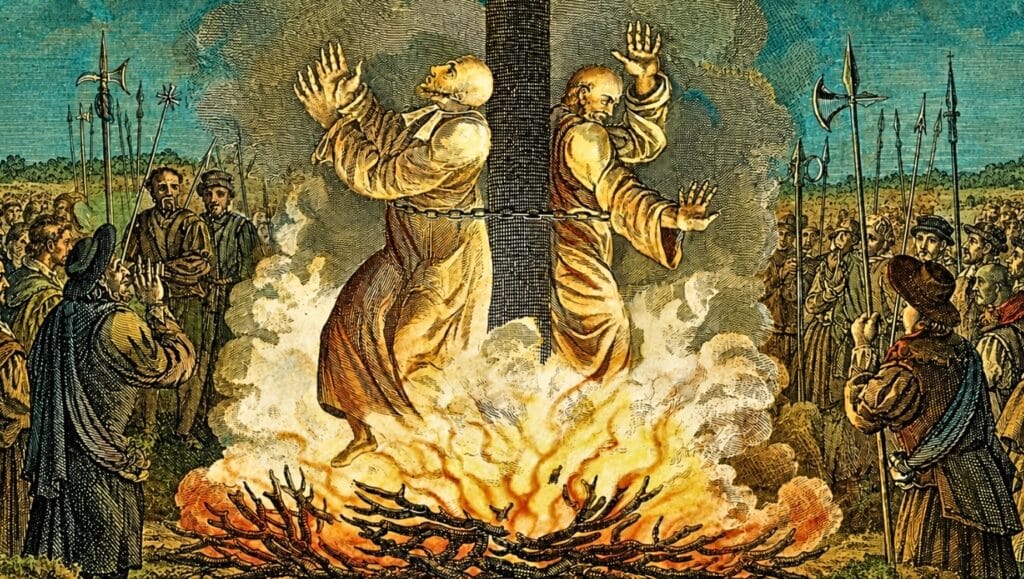
A Burning Candle: The Oxford Martyrs Latimer and Ridley
On October 16, 1555, in Oxford, England, Hugh Latimer and Nicholas Ridley, bishops in the English Church, died as martyrs. Bound back-to-back, they were burned at the stake.

