

The Poetry of All Saints: Three Sonnets for a Three-Day Feast
One of the best ways to keep a church feast is to read poetry on that day’s theme. Anglicans especially delight in these festive poems, both because we have a rich tradition of Anglican poets and because they often borrow from Scripture’s language and the rhythms of the Book of Common Prayer.
The poetry of All Saints is especially wonderful because it captures the multiple themes of the three-day feast, or triduum, often collectively known as Allhallowtide. In this article, I share three sonnets, by three Anglican poets, organized to fit the three days. For All Hallows’ Eve (October 31), read John Donne’s Holy Sonnet IV. For All Saints’ Day (November 1), read Christina Rossetti’s As grains of sand. And for All Souls’ Day (November 2), read Malcolm Guite’s The Last Beatitude. Together with the poems, I include brief introductory remarks and a concluding reflection.
Sponsored
All Hallows’ Eve: “Holy Sonnet IV” by John Donne
John Donne (1571–1631) opens this sonnet by imagining the day of general resurrection, when the saints return to their bodies to behold God and live forever. Don’t be confused by the first line; Donne plays on the irony that a spherical planet has no corners. The poetic effect is to show how much larger the earth really is than we typically imagine, and thus how it has been home to “numberless infinities / of souls.”
Two details make this sonnet especially fitting for Halloween, kept on October 31. First, Donne features a litany of death, similar to his more famous sonnet “Death be not proud,” but even more macabre, as it lists out the many modes of dying. Second, Donne pauses in his narration of the resurrection to consider his own repentance. Before we celebrate the saints, we should see the scope of our own sins and our need for forgiveness in Christ’s blood.
At the round earth’s imagin’d corners, blow
Your trumpets, angels, and arise, arise
From death, you numberless infinities
Of souls, and to your scatter’d bodies go;All whom the flood did, and fire shall o’erthrow,
All whom war, dearth, age, agues, tyrannies,
Despair, law, chance hath slain, and you whose eyes
Shall behold God and never taste death’s woe.But let them sleep, Lord, and me mourn a space,
For if above all these my sins abound,
‘Tis late to ask abundance of thy grace
When we are there; here on this lowly groundTeach me how to repent; for that’s as good
As if thou’hadst seal’d my pardon with thy blood.
All Saints’ Day: “As Grains of Sand” by Christina Rossetti
Christina Rossetti (1830–1894) struggled with depression for much of her life. Perhaps because of this struggle, she was also captivated by the blessedness of the saints. Amid the challenges of everyday sanctification, Rossetti drew inspiration from our fellowship with the martyrs and saints, who now enjoy Christ’s nearer presence.
Written in the last decade of her life, this sonnet reflects a close connection between God’s promises and the destiny of the saints. Its feeling of pure joy makes it especially fitting for All Saints’ Day, celebrated on November 1st. Notice how the opening stanza reflects God’s promises to Abraham: “grains of sand,” “stars,” and “holy land.” In other words, Rossetti connects the saints’ happiness, whose “love glows upward,” with God’s promised work, “because God is love.” You get the sense that Rossetti is triumphant, even over her own depression, when she writes: “What matters tribulation whence they came?”
As grains of sand, as stars, as drops of dew,
Numbered and treasured by the Almighty Hand,
The Saints triumphant throng that holy land
Where all things and Jerusalem are new.We know not half they sing or half they do,
But this we know, they rest and understand;
While like a conflagration freshly fanned,
Their love glows upward, outward, through and through.Lo! like a stream of incense launched on flame
Fresh Saints stream up from death to life above,
To shine among those others and rejoice.What matters tribulation whence they came?
All love, and only love, can find a voice
Where God makes glad His Saints, for God is Love.
All Souls’ Day: “The Last Beatitude” by Malcolm Guite
Malcolm Guite (1957–) wrote this sonnet specifically for All Souls Day, observed on November 2nd. All Souls remembers all the faithful departed amongst our family, friends, and congregations, including those now known to God alone. As Guite describes this poem, it is “a little sonnet about the ones we overlook, but whom God knows and loves intimately.”
When I read this poem, I can’t help but think personally of the various blessed souls I have known and buried in my own parish. It is a deep joy to consider that “God knows the depths” of each one, far more than the world and far more than me. (I have, however, always had a special appreciation for “the faithful servers on the coffee rota”!).
And blessèd are the ones we overlook;
The faithful servers on the coffee rota,
The ones who hold no candle, bell or book
But keep the books and tally up the quota,The gentle souls who come to ‘do the flowers’,
The quiet ones who organise the fete,
Church sitters who give up their weekday hours,
Doorkeepers who may open heaven’s gate.God knows the depths that often go unspoken
Amongst the shy, the quiet, and the kind,
Or the slow healing of a heart long broken
Placing each flower so for a year’s mind.Invisible on earth, without a voice,
In heaven their angels glory and rejoice.
In Conclusion: Delighting in the Saints
Why does the Anglican imagination delight in the feast of All Saints? I think we love it because it is both a Biblical truth about the end of time and a present hope that helps us on the pilgrimage of life. The communion of the saints is where time and eternity meet, where the body of Christ tears the veil between life and death.
And in a real sense, this communion with Christ and each other is a mystery we encounter every Sunday. In fact, we enter into this mystery every Sunday, often without thinking about it. But on the feast of All Saints, over its three days, we rediscover the stunning reality of our union with God’s Son, through whom we are reunited with each other.
Image: Gillingham Churchyard, Kent, by William James Müller (1831), courtesy of Wikimedia Commons. Digitally edited by Jacob Davis.
Published on

Halloween and the Victory of Christ
Halloween assures us of the ultimate comfort in our times of darkness. Taken together with the rest of Allhallowtide, it tells us that, though Satan’s forces still rage against us and this world’s ills plague our frail bodies and minds, Christ preserves his people from generation to generation.
10 Ways to Preach the All Saints Sermon
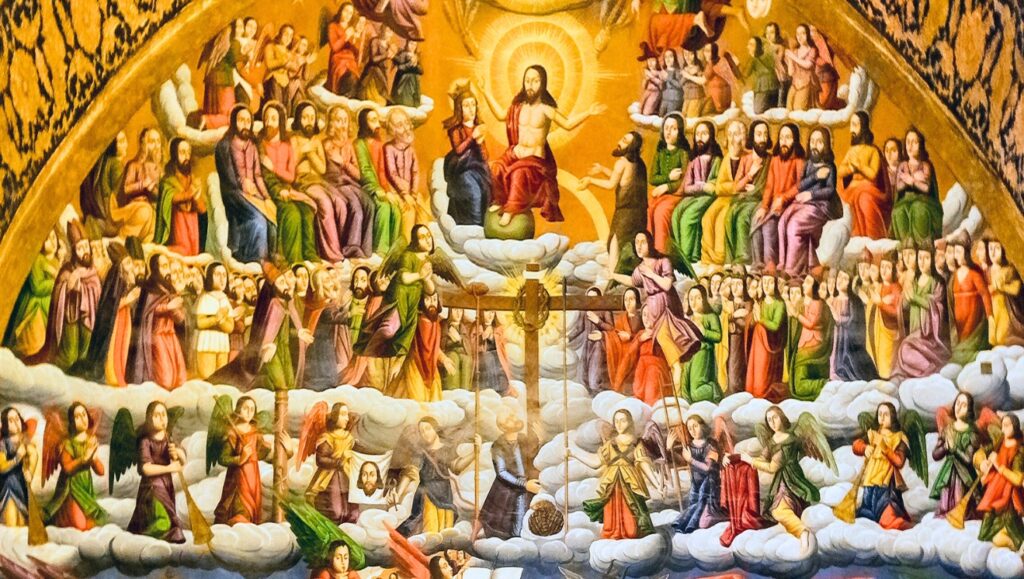
the Feast of All Saints gives the Church a way to celebrate and honor all known and unknown saints who have faithfully served Christ.

