

A People of One Book
“I want to know one thing—the way to heaven…Let me be homo unius libri [A man of one book]. Here, then, I am, far from the busy ways of men. I sit down alone: Only God is here. In his presence I open, I read his book; for this end, to find the way to heaven.”[1]
A man of one book. This phrase, originally in Latin, is allegedly traceable to St. Thomas Aquinas, although this may not be true. Anglican preacher and evangelist John Wesley took up this idea from his hero, Jeremy Taylor, another important Anglican divine. Wesley wanted his renewal movement, which reignited the Church of England, to be deeper than anything the Church was then offering but also simpler. This is a right and good impulse we see up and down the centuries of the Church. Wesley was a man of the Enlightenment, but his desire for a singularly focused heart and mind on the Bible has deep roots in the Anglican tradition.
The Bible: An Anglican Tradition
I love our Anglican tradition for many reasons. It’s been my home for most of my walk with Christ and has always felt like home. I could go on and on about our wonderful liturgy, the Church Year, the wonderful saints and divines in our tradition, or the beautifully balanced Reformed catholicity found in our doctrine. In the churches I have served at, I usually share the pews with many people who, unlike me, have come around to Anglicanism after reading a few books or having a few bad experiences at other churches. It attracts all sorts of people for all different reasons.
Sponsored
Sometimes, though, I don’t think any of those things really make people love our tradition. I think it’s because, at the end of the day, Anglicanism is a vehicle for one thing: God’s Holy Word. We, like Wesley, are people of one book. We read four passages straight from the Bible every Sunday, and we read four passages of Scripture every day at Morning and Evening Prayer. Our Prayer Book is essentially just the Bible arranged for prayer.
Being committed to this tradition for all the years I’ve been a Christian has turned me, against my own will sometimes, into a “man of one book.” Through listening to the Word proclaimed Sunday after Sunday and praying personally day after day, I can honestly say I know the Bible very well. I say this in absolute humility. Like I said, if it were up to me, I wouldn’t have been exposed to the Scripture like I have been. But recently, I’ve been learning that there’s more to just exposure, more than just knowledge about the Word.
Meat to Those Who Are Hungry
One of the more neglected parts of our Anglican formularies, the Book of Homilies, starts off with a crackling exhortation to get one’s head in The Book. Archbishop Cranmer asks his people, “What excuse shall we, therefore, make at the last day before Christ, if we delight to read or hear human fantasies and inventions more than his most holy gospel, and will find no time to do that which chiefly above all things we should do?”[2] Do you think people wasting their time on Netflix and video games is a modern problem? Even in the early decades of the Reformation, when the Bible was first made available to the English people, the Scriptures were being neglected for things that seemed more entertaining.
Many of us in the Church often feel guilty for not reading our bibles enough, even though we have plenty of translations, affordable study bibles, and tons of online resources. I know many folks who have already recommitted themselves this January to a Bible-in-a-year reading plan. Without diminishing a wonderful commitment like this, often these sorts of yearly recommitments are reminders of what we neglected in the previous year. If I’m really honest, my screen time is not up because of YouVersion and BibleProject. There are just too many exciting things to get involved in that aren’t the Bible. There’s a constant stream of content that dominates our entire existence these days. It’s at least comforting to know that it’s nothing new. Cranmer felt the same wandering tendency in his day.
But Cranmer has more to say than just how often we are reading the Bible as compared to other things. There is a posture to properly reading Scripture:
As drink is pleasant to those who are dry, and meat to those who are hungry, so is the reading, hearing, searching, and studying of holy scripture, to those who desire to know God, or themselves, and to do his will.[3]
This is from the same Archbishop who reminds us every Advent to “inwardly digest” the Scripture. The Bible is food. It is the Bread of Life. It’s how Christians survive. This requires more than just lots of exposure to the Bible. It requires a deep reading, deeper even than finding inspiration in a verse or mining the text for doctrine.
Approaching the Heavenly Food
As many Awana graduates can tell you, Heaven will not open to us after we pass a Bible quiz. As the Bible will tell you, Heaven opens to us when we trust in Jesus. The Word of God is not simply an end to itself but a means to communion with the Lord Jesus. It’s a bridge to life, to the only thing we truly need. How, then, ought we to approach this heavenly food?
In a wonderful little book on the practice of lectio divina called Sacred Reading by Michael Casey, a monk at Tarrawarra Abbey in Australia, Casey reminds us that early monastics really only had one book. They didn’t need Rev. Wesley to remind them to read attentively. There really wasn’t the option to read other books. Because of this literary scarcity, they read every book with an attentiveness and yearning for heart knowledge very different from our modern, distracted sort of reading. “It was the rarity of books that dictated the style of reading,” Casey writes. “There was no place for light reading.”[4] What if we read the Bible like there really was nothing else to do?
Soren Kierkegaard has a book titled Purity of Heart is to Will One Thing. This is what saints do. Saints listen to one viewpoint. They are not well-rounded and balanced. They don’t consider their options. Their bibliography is very short. David said the Psalms were a lantern to his feet. What is lighting my path? Am I tripping over myself as I walk through the world because I haven’t committed myself to the Light of the World? Where do I hear God’s voice every day? As an Anglican, I can give you a very clear and simple answer. Praise God for this wonderful tradition of Anglicanism which has started and ended all my days as a Christian in the right way: with my eyes on The Book.
Footnotes
[1] John Wesley, preface to Sermons on Several Occasions Vol. 1
[2] Thomas Cranmer (translated by Lee Gatiss). “On The Reading of Scripture” in The First Book of Homilies: The Church of England’s Official Sermons in Modern English. Lost Coin Books, 2021. pg. 38
[3] Cranmer, pg. 32
[4] Michael Casey. Sacred Reading: The Ancient Art of Lectio Divina. Liguori Publications, 1996.
Photo by Pierre Bamin on Unsplash.
Published on


The Standard of Prayer Book Worship (Jerusalem Declaration 6)
We rejoice in our Anglican sacramental and liturgical heritage as an expression of the gospel, and we uphold the 1662 Book of Common Prayer as a true and authoritative standard of worship and prayer, to be translated and locally adapted for each culture.
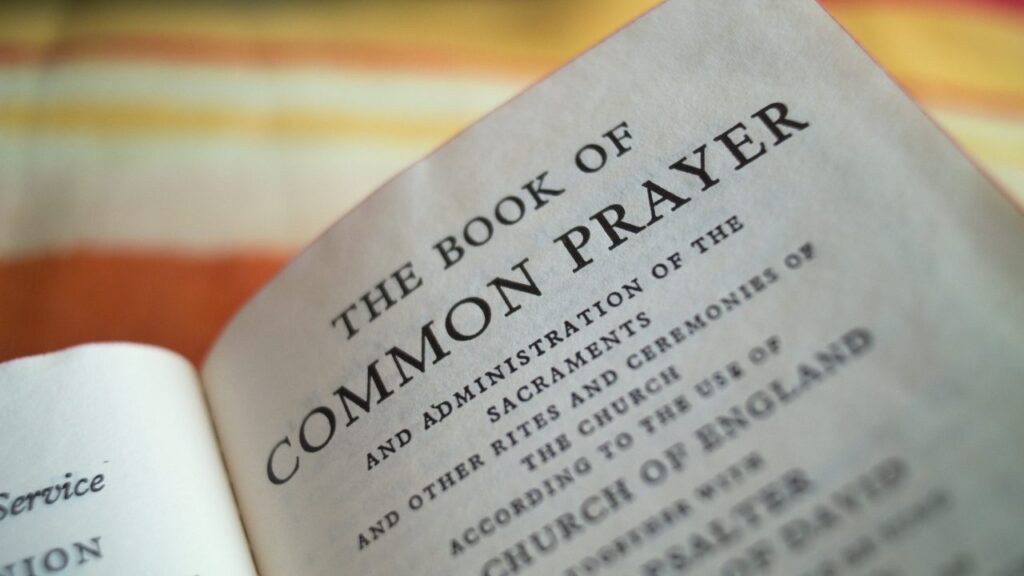
The 1662 Book of Common Prayer: The One Prayer Book Every Rookie Anglican Needs
A liturgy makes it easier to pray with others, and to pray with the church—past, present, and future. Liturgical prayers are not the only kind, but there is something special about them. These prayers can be etched on your heart, taught to your children, and remembered at the close of life. For Anglicans, these prayers…
