

Hymn Guide: All Creatures of our God and King
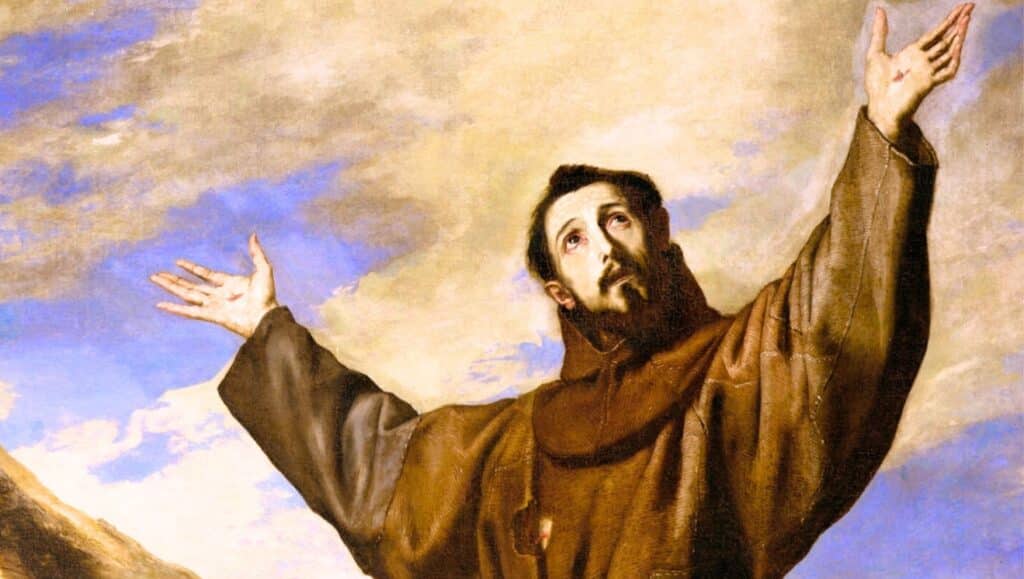
“All Creatures of our God and King” is a favorite hymn of praise that exhorts all creatures to join in the great Alleluia to God. Based on Saint Francis’s “Canticle of the Sun,” written around 1225, it reflects Francis’s core idea that we humans are siblings with all other creatures because God created us all.
Anglican priest William Henry Draper paraphrased Francis’ Italian canticle into English to create the text of the hymn that we sing today. Then, in 1919, the text was paired with a majestic German tune, LASST UNS ERFREUEN. Draper first used the hymn for the celebration of Pentecost, and the hymn is also suitable for any season of praise or feast related to the creation, including the Easter Season, Rogation Days, and, of course, the Feast of Saint Francis.
Sponsored
Verse by Verse
Verse 1
Each verse of the hymn is focused on a particular set of creatures, organized thematically. As in Psalm 148, those creatures are directly addressed and then exhorted to sing in praise of God and join the Alleluia of creation. The first verse focuses on “thou burning sun” and “thou silver moon,” though it is interesting to note that Francis’ original Italian text read “brother sun” and “sister moon”:
All creatures of our God and King
Lift up your voice and with us sing
Alleluia, alleluia!
Thou burning sun with golden beam,
Thou silver moon with softer gleam,
Every verse concludes with a refrain of praise and a triple alleluia.
O praise him, O praise him
Alleluia, alleluia, alleluia.
Verse 2
The second verse is also oriented to the sky. However, instead of the luminaries, the focus is on winds, clouds, morning, and the stars of night.
Thou rushing wind that art so strong
Ye clouds that sail in heaven along
O praise him, alleluia!
Thou rising morn in praise rejoice
Ye lights of evening find a voice
O praise him…
Verse 3
Having identified wind in the second verse, the third verse identifies water and fire:
Thou flowing water, pure and clear,
Make music for thy Lord to hear,
Alleluia, alleluia!
Thou fire so masterful and bright
That gives man both warmth and light
O praise him…
Verse 4
The fourth verse references “mother earth,” completing the hymn’s reference to the four classical elements (earth, water, air, fire). But the fourth verse is often not sung, partly because of length and partly because of sensitivity around the phrase “mother earth.” In this regard, it ought to be noted that Francis’ original Italian text actually read “sister mother earth,” clarifying that even earth is our sibling as a fellow creature of God.
Dear mother earth, who day by day
Unfoldest blessings on our way,
O praise him, alleluia!
The flowers and fruits that in thee grow
Let them his glory also show
O praise him…
Verse 5
The fifth verse shifts attention from the natural world to the human world, not unlike the way the Creation narrative in Genesis 1 concludes with the creation of man and woman. The focus, however, is not on mankind merely but on the interior life of the heart, with a call to forgiveness, patience, and long suffering.
And all ye men of tender heart,
Forgiving others, take your part,
O sing ye, alleluia!
Ye who long pain and sorrow bear,
Praise God and cast on him your care,
O praise him…
Verse 6
The sixth verse invokes death itself. Again, this verse is often unsung, perhaps due to its length, but also because of sensitivity to the phrase “most kind and gentle death.” For Christians, of course, death is our great enemy, which makes it strange to call it kind or gentle. However, Francis appears to be drawing on the idea that, after Christ’s resurrection, death no longer holds ultimate power. Instead, death becomes a tool of God to bring God’s children home.
And thou, most kind and gentle death,
Waiting to hush our latest breath
O praise him, alleluia!
Thou leadest home the child of God,
And Christ our Lord the way hath trod:
O praise him…
Verse 7
The final verse returns to the theme of the first, speaking to all things and encouraging them to humble praise of their Trinitarian Creator God:
Let all things their Creator bless
And worship him in humbleness
O praise him, alleluia!
Praise, praise the Father, praise the Son,
And praise the Spirit, Three in One:
O praise him, O praise him
Alleluia, alleluia, alleluia.
On Video
The first video features an organ and choir from Salisbury Cathedral. Note especially the lovely descant on the final verse. The second video presents a modern setting by King’s Kaleidoscope, a band based in Seattle. Note the broad instrumentation, featuring a trombone, trumpet, xylophone, flute, violin, and cello, alongside the traditional instruments of guitar, bass, piano, and drums. For King’s Kaleidoscope, “All Creatures” includes “All Instruments“!
Photo by Mike Pellinni, courtesy of Canva.
The Feast of St. Francis: A Rookie Anglican Guide
Francis has much to teach us even today from his life of simplicity, care for the poor, and ability to wonder at God through the natural world.

Hymn Guide: Be Thou My Vision
Did you know “Be Thou My Vision” was written by a blind monk? The text is traditionally attributed to Saint Dallán, a 6th-century Celtic monk who went blind in the middle of his life. Some modern scholars have argued for a later date in the 10th or 11th century. Either way, the text reflects the…
