

Book Review: The Mythmakers, by John Hendrix
John Hendrix, The Mythmakers: The Remarkable Fellowship of C.S. Lewis & J.R.R Tolkien. Abrams, 2024. 224pp.
The friendship between C.S. “Jack” Lewis and J.R.R. “Tollers” Tolkien is the stuff of legend. The two Oxford dons met in 1926, before Lewis’ conversion to Christianity and long before they would both become famous fantasy authors. They quickly bonded over a shared love of Norse myths, a common interest that would lead Lewis to what he called the “true myth” of Jesus Christ. Lewis himself, in his spiritual autobiography Surprised by Joy, recounts Tolkien’s essential role in shaping his religious thought. Every subsequent biography of Lewis also gives attention to this friendship.
The Mythmakers, written and illustrated by veteran artist John Hendrix, depicts the friendship of Lewis and Tolkien as a graphic novel. The book’s core is a rich evocation, in both words and images, of the embodied friendship between Lewis and Tolkien. As readers, we get a taste of their mutual experience of the First World War, their shared fascination with literature and myth, their love of walks, conversation, and laughter, and most especially the pleasure of a pint and good talk by a fire.
But don’t be fooled: this is a book for adults and interested teenagers more than it is for young children. Children may be intrigued by the illustrations, but will probably find it difficult to follow the extensive discussion of myth and literary genres. But teens or adults who are interested in Lewis and Tolkien, and who appreciate visual illustration, will find themselves enchanted and engrossed. For such a person, The Mythmakers will prove a perfect Christmas or birthday gift.
The Lion and the Wizard as Guides to Myth
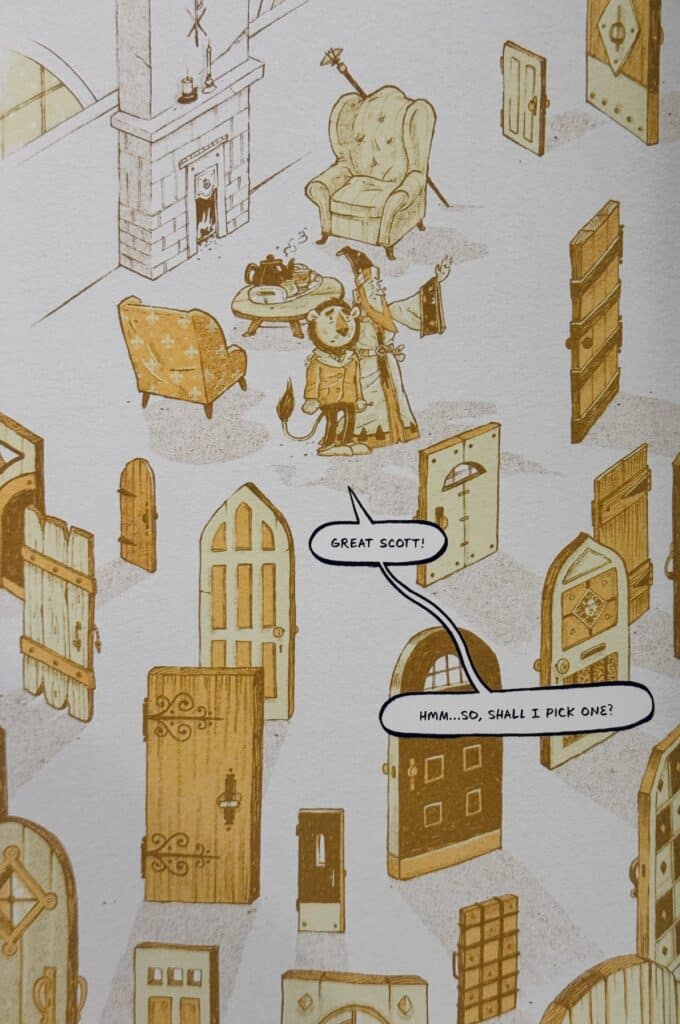
To tell the story of Lewis and Tolkien, Hendrix uses a set of narrators, appropriately personified as a lion and a wizard. These two narrators have a running conversation, in which they both tell and comment on the intertwining stories of Lewis and Tolkien. They also lead the reader, both at the beginning of the book and at various points throughout, in an exploration of the meaning of myth.
Hendrix’s goal is not just to show the reader that Lewis and Tolkien bonded over myth, but to help him understand why myths mattered so much to them. In a sense, Hendrix aims to put us inside the minds of Lewis and Tolkien, so we can catch a glimpse of the subjective context that gave birth to Middle-earth and Narnia.
Friendship and Illustrated Biography
As an entry in the historiography of Lewis and Tolkien, The Mythmakers is unique for at least two reasons. First, and most obviously, this entry is unique because it borrows the form of a graphic novel to tell the lives of Lewis and Tolkien. I call this genre “illustrated biography,” which helps distinguish the work from fiction and children’s literature. Here Hendrix builds on his previous work, especially “The Faithful Spy,” an illustrated biography of Dietrich Bonhoeffer.
With his illustrations, Hendrix not only gives visual expression to the friendship; he also helps the reader feel the shared context and interests that made it so strong. We feel the shared environments of the trenches on the Western Front, of postwar Oxford, and especially of Magdalen College where Lewis and Tolkien held so many of their significant conversations. Hendrix helps us to feel the truth of what Lewis would later write to explain the beginning of friendships:
The typical expression of opening Friendship would be something like, ‘What? You too? I thought I was the only one.
C.S. Lewis, The Four Loves
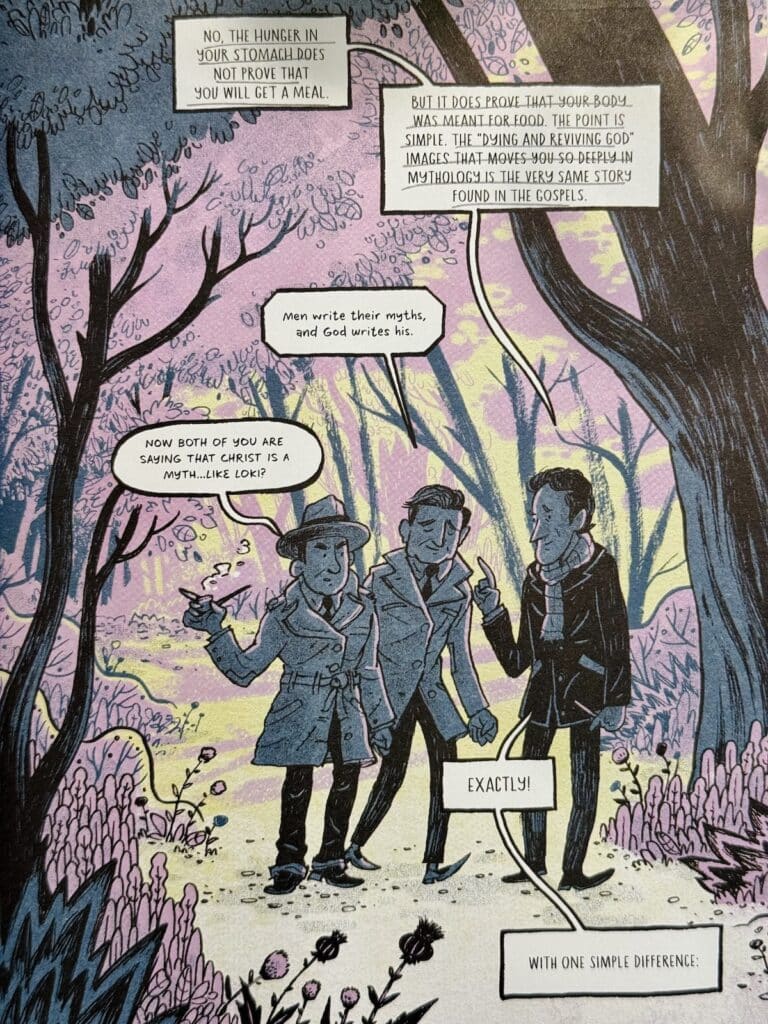
In the image below, for example, Hendrix depicts the fateful evening conversation on Addison’s Walk, between Lewis, Tolkien and Hugo Dyson, just before Lewis began to believe in God.
A Friendship of Literary Dynamism
A second distinguishing feature of The Mythmakers is its focus on the literary dynamism of the friendship between Lewis and Tolkien, even more than on their parallel religious journeys. We learn about Lewis and Tolkien’s mutual love of myth and their desire to create new myths for adults through fantastic, imaginative worlds. Most of all, Hendrix’s book also argues that Lewis and Tolkien were indispensable to each other’s creative work. Tolkien helped Lewis integrate his head and his heart and thereafter produce stories deeply infused with the Christian mythos. Similarly, Lewis offered to Tolkien the essential encouragement without which he would neither have completed nor published his work.
Hendrix also includes the broader group of friends whom Lewis and Tolkien brought into their literary life, a group they called “The Inklings.” The effect is not only to tell us more about their group of friends, but also, in a sense, to invite us as readers to share the fellowship of the Inklings. In his article on C.S. Lewis’ view of friendship, Jacob Davis points out how, for Lewis, the Inklings brought out each other’s unique graces. He quotes Lewis describing how the loss of one friend actually means the loss of certain aspects of other friends who remained:
In each of my friends there is something that only some other friend can fully bring out… Now that Charles is dead, I shall never again see Ronald’s reaction to a specifically Caroline joke. Far from having more of Ronald, having him “to myself” now that Charles is away, I have less of Ronald. Hence true friendship is the least jealous of loves. Two friends delight to be joined by a third, and three by a fourth, if only the newcomer is qualified to become a real friend.
C.S. Lewis, The Four Loves
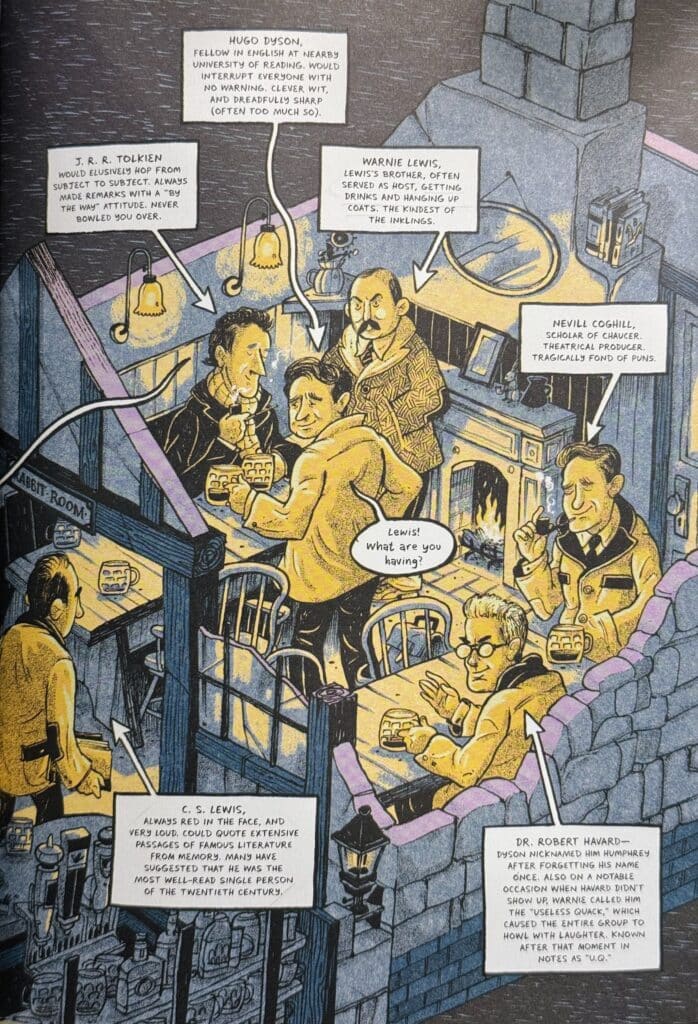
In the images below, Hendrix shows the inklings at the Eagle & Child, in the Rabbit Room. We learn the characters’ identities, but most of all we catch a sense of their friendship.
An Anglican Recommendation
I recommend this book to Anglicans for three reasons. First, by encountering the backstory of C.S. Lewis, in his atheism and subsequent conversion, we should be encouraged by the truth that God works wonders in and through those who seem far off from Christ. We ought to consider: to whom in our lives can we be a Tolkien? Where can we develop genuine friendships with non-believers?
Second, the creative dynamism of Lewis and Tolkien shows us that we can have wonderful and deeply productive friendships with Christians of other denominations (Tolkien was Roman Catholic).
Third, as Anglicans, let’s reclaim the heritage of the fine arts which is central to our tradition. Lewis, Tolkien, and this book itself all demonstrate that we, made in the image of God, can rediscover the enchantment of God’s creation through our own works of sub-creation.
The Breaking of the Fellowship
Any treatment of the friendship of “Jack” and “Tollers” must grapple with its decline in their later years, and especially their severe disagreement over Lewis’ Narnia series. While Lewis had been the chief (and at first, the only) champion of Tolkien’s Middle-earth, Tolkien rejected Narnia outright. Evocatively, Hendrix titles this period “the Breaking of the Fellowship” and uses his lion and wizard characters to speculate on some reasons for their falling out. A brief selection will help illustrate:
Wizard: So why do you think Tolkien disliked the first Narnia story so intensely?
Lion: It is…complicated. Tolkien believed that without Logos, the Mythos was not possible. Adding to that, Lewis wrote all seven Narnia books in seven years! Tolkien had, at this point, invested over a decade into but the first draft of The Lord of the Rings.
Wizard: MMPH. I would guess that some of it was jealousy.
Lion: Perhaps Lewis’ haste, to Tolkien, must have seemed almost indecent. In his mind, the fact that writing came so easily to Lewis cast suspicion on Narnia’s construction.
Wizard: Rubbish! Tolkien simply had never been fond of allegory, especially Christian allegory!
Lion: It must be said that for Lewis’ part, He believed that the Narnia stories were more of a “Supposal” than classic allegory. More to the heart of the disagreement: I think Tolkien saw these stories as a kind of betrayal. Not only was Lewis giving up on their shared project of rich fantasy writing for adults, but to Tolkien, it appeared that Lewis had just made a hasty and haphazard stew of many different mythologies. He also felt Lewis borrowed some of his ideas without doing the hard work of sub-creation.
Wizard: Well, he’s got a point about the stew.
The Mythmakers, pp.147-149
But for Hendrix, the sad breaking of the fellowship also becomes the occasion for the most moving moment in The Mythmakers. At the end of the book, Hendrix imagines a transfiguration in which Lewis and Tolkien reunite for a final conversation beyond the grave. I won’t reveal the details of the conversation, since the reader will want to experience this moment without spoilers. Suffice it to say, I wept.
Hendrix’s brilliant conclusion reveals that he is just as much a mythmaker as his protagonists Lewis and Tolkien. I guess the magic of the masters is rubbing off, or even better: the myths keep coming true.
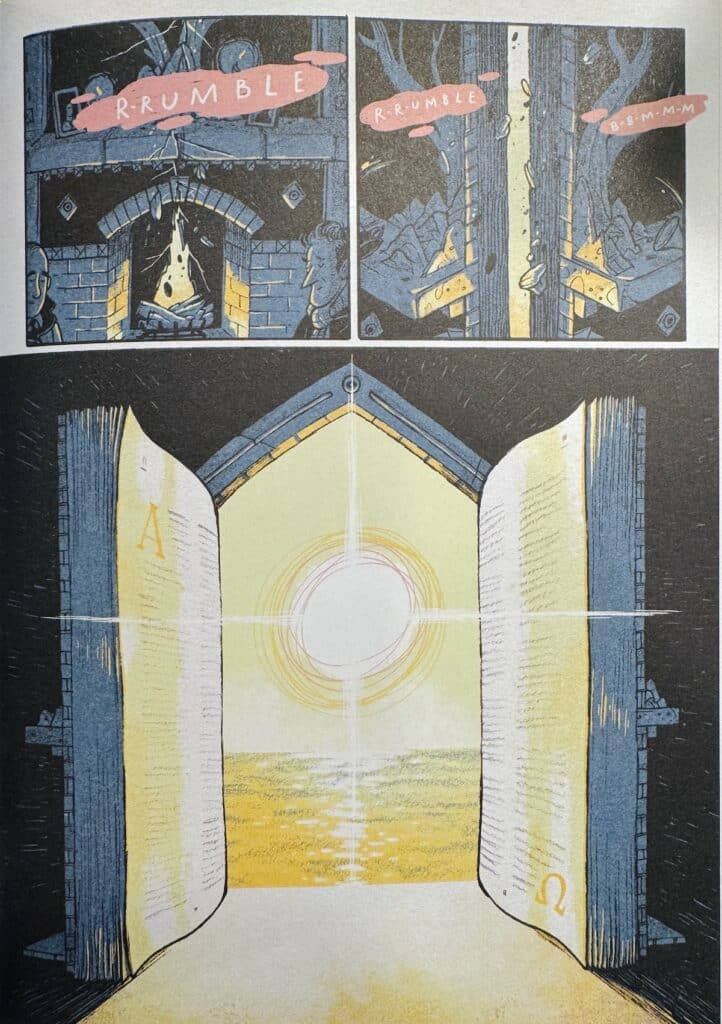
Image: The Mythmakers, © 2024 Abrams.
Published on

Author
Peter Johnston
The Ven. Dr. Peter Johnston is the Ministry President of Anglican Compass. He is a priest and archdeacon in the Anglican Diocese of All Nations and the rector of Trinity Lafayette. He lives with his wife, Carla, and their nine children near Lafayette, Louisiana.

The Abolition of Man: C.S. Lewis’s Most Prophetic Work of Nonfiction
Published as The Abolition of Man, Lewis’s lectures offered a stark warning: Western civilization was abandoning its commitment to objective truth and moral value in favor of moral relativism.

The Greatest of Worldly Goods: C.S. Lewis on Friendship
Lewis claims, “Friendship is unnecessary, like philosophy, like art… it has no survival value; rather it is one of those things that give value to survival.”
Subscribe
Enter your details below to get our emails.
Comments
Please comment with both clarity and charity.
Loading comments…