

Hymn Guide: Now Thank We All Our God
“Now Thank We All Our God” is a simple hymn of thanks with a surprising origin story. Today we sing it at meals, in church, and especially in the United States and Canada during the observance of Thanksgiving Day. Its tune, NUN DANKET ALLE GOTT, is hearty and memorable, like a Thanksgiving turkey with stuffing and cranberry sauce. From the hymn’s deep sense of gratitude, you might think the author, Lutheran deacon Martin Rinkart, lived a life of abundance and ease.
But Rinkart wrote the hymn during the Thirty Years’ War, amid severe suffering and loss. His hometown of Eilenberg became a refuge for thousands who sought protection, but the crowding of the city led to devastating illness. In 1637, the plague killed or drove out all the other ministers in the town, and Rinkart officiated 4000 funerals, including the burial of his wife. How could a man with such bitter experiences compose such a sweet hymn of thanks? Only by God’s grace, which teaches us in our grief to draw ever closer to our faithful Savior, Jesus Christ.
Verse by Verse
Verse 1
Now thank we all our God
with heart and hands and voices,
who wondrous things has done,
in whom his world rejoices;
who from our mothers’ arms
has blessed us on our way
with countless gifts of love,
and still is ours today.
The hymn was written as a simple grace before a meal, which is reflected in the call to thanks with “hearts and hands and voices.” We offer thanks because this God has done wondrous things and because he is a true object of rejoicing. A key insight here is that we can always rejoice in God; even when everything else in our life fails, God does not fail and therefore is worthy of rejoicing.
Note also that the hymn connects God’s gifts to us with the people that he uses to bless us, most especially our mothers. By putting us in mind of our own parents and our own childhood, the hymn reminds us of our own childhood and encourages us to see ourselves as children of our Father in heaven. I am reminded of Jesus’s teaching that God delights to bless his children, especially when they ask:
Which one of you, if his son asks him for bread, will give him a stone? Or if he asks for a fish, will give him a serpent? If you then, who are evil, know how to give good gifts to your children, how much more will your Father who is in heaven give good things to those who ask him!
Matthew 7:9-11
After thanking God in the first verse, the second verse turns to a request.
Verse 2
O may this bounteous God
through all our life be near us,
with ever joyful hearts
and blessed peace to cheer us,
to keep us in his grace,
and guide us when perplexed,
and free us from all ills
of this world and the next.
The most important request is that God remain near us through all our lives. In his presence, we may continue through our trials “with ever joyful hearts” and “blessed peace to cheer us.”
Of course such peace can be easier said than experienced, which is why the verse also includes a request that God’s grace “guide us when perplexed.” The hymn is realistic in its prayer, asking that we be delivered from “all ills,” if not in “this world” then “in the next.”
Verse 3
All praise and thanks to God
the Father now be given,
the Son and Spirit blest,
who reign in highest heaven
the one eternal God,
whom heaven and earth adore;
for thus it was, is now,
and shall be evermore.
Having made its prayer, the hymn returns to the theme of praise and thanks in its closing trinitarian doxology.
The simplicity of this final verse, and indeed of the hymn as a whole, can feel at first glance a bit naive. But there is a deeper spiritual realism and maturity in thanking God no matter the circumstances of life. The painting at the top of this article, The Funeral Meal by Leon Frederic, captures this dynamic by showing the combination of grief and a determination to pray. Indeed, I suspect Rinkart understood these truths precisely because of his extensive experience with burials and funeral services.
Without denying our grief, the practice of gratitude can help to restore our peace. It is no coincidence that Paul exhorts the Philippians to rejoice in God and offer their thanks, before promising them the peace of God. Rinkart’s hymn encourages us to do the same, even as we go through our own seasons of loss:
Rejoice in the Lord always; again I will say, rejoice. Let your reasonableness be known to everyone. The Lord is at hand; do not be anxious about anything, but in everything by prayer and supplication with thanksgiving let your requests be made known to God. And the peace of God, which surpasses all understanding, will guard your hearts and your minds in Christ Jesus.
Philippians 4:4-7
On Video
The first video is a majestic rendition from Westminster Cathedral, with a boys’ choir, organ, and brass in the last verse. It is sung alongside a beautiful procession of Commonwealth Flags. The second video, in a very different mode, is sung solo by Ghanaian contemporary Christian artist LOR, with backing keyboard and guitar. This video reflects the hymn’s popularity in Africa.
Image: The Funeral Meal (1886) by Leon Frederic, courtesy of Wikimedia Commons. Digital editing by Peter Johnston.

Published on
Author
Peter Johnston
The Ven. Dr. Peter Johnston is the Ministry President of Anglican Compass. He is a priest and archdeacon in the Anglican Diocese of All Nations and the rector of Trinity Lafayette. He lives with his wife, Carla, and their nine children near Lafayette, Louisiana.

Hymn Guide: God Be Merciful To Me
“God be merciful to me” is a setting of Psalm 51, David’s great hymn of repentance, forgiveness, and faith. More than most hymns and worship songs, it sets forth the stark reality of human sin and turns to God as our only hope for salvation and spiritual renewal. Composed anonymously for the 1912 Psalter, it
Hymn Guide: Come, Ye Thankful People, Come
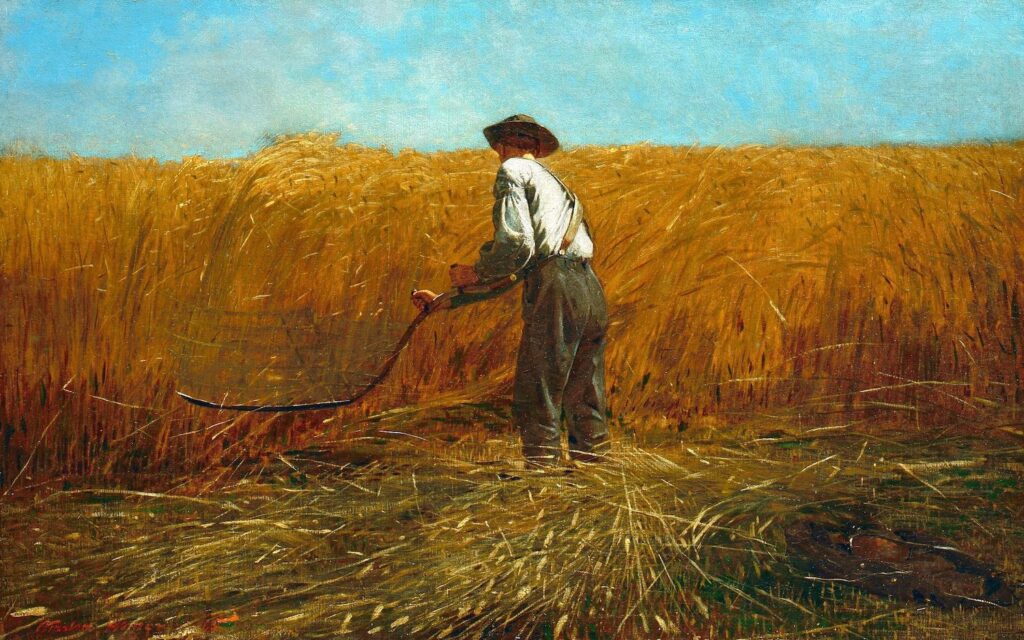
A beloved hymn for Thanksgiving, “Come, ye thankful people, come” is also a fitting hymn for Advent. It presents a rare combination of thanks and judgment, drawing singers into reverent awe before the Almighty. Anglican priest Henry Alford wrote the hymn in 1844 and published it under the heading, “After Harvest.” At the time Alford
Subscribe
Enter your details below to get our emails.
Comments
Please comment with both clarity and charity.
Loading comments…