

Remember Lot’s Wife: When Nostalgia Keeps Us Looking Back
What memories surface first when you look back? What emotions are attached to these memories? Do you feel joy and gratitude, regret and shame, or justification and guilt?
Genesis 19 tells a dramatic story. Angels urgently lead Lot and his family to escape the fire and brimstone about to rain down on Sodom and Gomorrah. It is an account of destruction, deliverance, and the danger of looking back toward what God calls us to leave behind.

Sponsored
Lot, Abraham’s nephew, settled near Sodom after conflict arose between their herdsmen. He moved his family to the fertile Jordan Valley and eventually made his home in Sodom. There he established his household and sat at the city gate—a place associated with civic life and influence. Sodom was notorious for its wickedness and violence, yet Lot remained despite the surrounding corruption.
One evening, two angels arrive. When the men of the city threaten to assault these visitors, Lot brings them into his home for protection, even offering his virgin daughters to the mob in their place. The angels intervene, protecting Lot and his family from the violence outside.
At daybreak, the angels urge Lot and his family to flee, but Lot hesitates. In an extraordinary act of mercy, the angels take them by the hand and lead them out of the city to safety. They are instructed to flee and not look back.
As fire and brimstone rain down upon Sodom and Gomorrah, Lot’s wife looks back. In that moment, she becomes a pillar of salt. What good is a pillar of salt in a barren desert landscape?
When God Seems Unmerciful?
As a child, I thought the consequence was cruel. I viewed God as a scary, invisible, and punitive being who seemed eager to punish us at every opportunity. This story, and especially the consequence for Lot’s wife, only reinforced that perspective.
I understand the urge to look back. Imagine watching your home—a place where you built a life, celebrated first steps, and made countless memories—being destroyed by fire falling from the sky. When we moved, I struggled to watch my husband paint over the wall where I had recorded my children’s growth since their earliest years. That wall held years of memories, and I wasn’t ready to let the symbol of those memories go. Somehow, the paint seemed harsh. I suspect the desire to look back would have been strong for me, too.
It is human to form our understanding of God around our own experiences and their consequences. Sometimes, we feel resentful about relinquishing things we value—whether good or unhealthy. Letting go can be painful. When we resist letting go, we may struggle to recognize God’s goodness, instead seeing him as a punitive overlord who forced us to give up something we believed was beneficial.
But the pain of relinquishing something does not, by itself, tell us whether God is being cruel or merciful, or whether we are experiencing a test of faith. It is a thinking error to believe that God’s favor is measured by tangible rewards or that His favor guarantees a comfortable, easy life.
We experience the consequences of actions—sometimes our own and sometimes those of others. For some experiences, no satisfactory explanation will ever exist. Perhaps they are simply part of the human condition in a fallen world.
God’s mercy calls us to flee from sin, even when we seem to leave everything behind. Not every pleasant memory draws us toward something good. Sometimes, what we remember fondly can obscure what we ought to leave behind.
The Sweetness of Turkish Delight
In C. S. Lewis’ The Lion, the Witch and the Wardrobe, Edmund’s craving for Turkish delight draws him toward the White Witch. The enchanted Turkish delight gives him a reason to return, while the Witch promises him power and importance in exchange for his allegiance. Even as he begins to recognize her wickedness, he remains drawn to what she has promised. The memory of the Turkish delight makes it easier to overlook the danger of returning. What Edmund remembers is what he desires, not the wickedness of the one who offered it. Sin promises what it cannot deliver.
What keeps you looking back? Maybe it’s a painful situation in which you wish things had turned out differently. Perhaps it’s rehearsing a conversation and the responses you wish you had offered in a painful moment. Or perhaps it’s remembering a fond time, the “good old days,” when you felt a sense of belonging yet were walking in sin.
Unhealthy nostalgia draws us toward a warmly remembered past while overlooking temptation and sin.
Remembering Well
I love the movie National Lampoon’s Christmas Vacation. Clark Griswold, played by Chevy Chase, is determined to create a good old-fashioned family Christmas. In one scene, he finds himself trapped in the attic, surrounded by junk and memorabilia, watching old family movies. Despite the cold, he finds warmth in remembering the grace of connection with loved ones. Memory is a gift. Clark’s insistence on recreating an ideal Christmas creates hilarity precisely because his longing is so relatable.
But what about those less-than-virtuous memories we revisit with nostalgia? Think of those seasons of life when we were engaged in sinful behavior, yet the memories remain pleasant. What happens when nostalgia’s warmth makes it hard to remember the past truthfully?
Some memories become monuments in our minds, serving as unhealthy attachments that tether us to the past. These monuments honor the pleasure and belonging we experienced while leaving the harm we caused or excused unmarked. Over time, our attachment to these monuments can become lonely and burdensome. Idealization can make it difficult to appreciate the goodness of what we have now.
We may remember the belonging fondly while overlooking behaviors we would now recognize as sinful. Our sense of belonging is often rooted in relationships with others, relationships that can change, fade, or even end painfully. When a connection is anchored in unprincipled behavior, it can be difficult to remain in the relationship while establishing healthier boundaries. Lot’s wife fled Sodom in a dramatic rescue, leaving behind her home, her relationships, a community marked by profound moral corruption, and the life she had known. Sometimes, what feels like the loss of belonging may actually be an act of deliverance.
Remembering Christ
What do we experience at the Eucharist? I can eat bread and drink wine at my dinner table. The Eucharist is an embodied experience that engages our bodies, attention, and memory. We hear the liturgy, stand in praise, kneel in humility for confession, remember Christ’s saving death, and receive his Body and Blood. Regular Eucharist attendance gives us the opportunity to form new memories through repeated, familiar experiences. Over time, participation helps form a different kind of monument in our minds—one that bears witness to his mercy and helps us remember truthfully.
Article XXVIII of the Thirty-Nine Articles states:
The Supper of the Lord is not only a sign of the love that Christians ought to have among themselves one to another, but rather it is a Sacrament of our Redemption by Christ’s death: insomuch that to such as rightly, worthily, and with faith, receive the same, the Bread which we break is a partaking of the Body of Christ; and likewise the Cup of Blessing is a partaking of the Blood of Christ.
The Thirty-Nine Articles of Religion, Article XXVIII, “Of the Lord’s Supper”
Consider the context of the Last Supper. On the night before his crucifixion, Jesus institutes the sacrament of the Eucharist. He invites the disciples to receive from him, saying:
“Take, eat; this is my body… Drink of it, all of you, for this is my blood of the covenant, which is poured out for many for the forgiveness of sins.”
Matthew 26:26–28
How often do we receive the Body and Blood of Christ out of habit while refusing to let go of what draws us away from him? Like the apostles, we can accept or decline Christ’s full redemptive gift. Redemption calls us to surrender our sinful desires and embrace his life. We can receive his gift with humility and gratitude, remembering his sacrifice, or turn away. The choice is yours.
We can return to the table again and again. We cannot relive the past, but we can keep forming healthy, truthful memories as we receive Christ in the present.
Remembering the Gifts of Baptism
Baptism is more than an announcement that I have prayed a prayer and want to follow Jesus. Our tradition invites us to seriously consider the life we choose in Christ through our baptismal vows:
Do you renounce the devil and all the spiritual forces of wickedness that rebel against God?
Do you renounce the empty promises and deadly deceits of this world that corrupt and destroy the creatures of God?
Do you renounce the sinful desires of the flesh that draw you from the love of God?
Holy Baptism, Book of Common Prayer (2019)
Our liturgy calls us to remember these promises throughout our Christian lives—anticipating that we will struggle with idealized nostalgia. How often do we long for the very things we renounce?
St. Cyril of Jerusalem, my favorite saint of the past, lived in the fourth century. He was known for the way he catechized new converts. In his first catechetical lecture, St. Cyril describes both the gift of God’s grace and our responsibility to receive and cherish it:
The recipients of this spiritual and saving seal must have the proper disposition… Instead of catechumen, you will now be called a Believer. From now on, you are grafted upon the stock of a spiritual olive, like a slip transplanted from wild olive into the good olive tree, from sin to righteousness, from corruption to purity… It rests with God to bestow grace, but with you to accept and cherish it. Do not despise the grace because it is freely given, but rather cherish it with reverence once you have received it.
Cyril of Jerusalem, The Works of Saint Cyril of Jerusalem, vol. 1, trans. Leo P. McCauley, S.J., and Anthony A. Stephenson (Washington, DC: The Catholic University of America Press, 2017), 93.
Holy Scripture does not reveal Lot’s wife’s thoughts or intentions. Mercy calls us forward, and when we idealize the past, we risk becoming frozen, much like Lot’s wife.
Thankfully, God’s grace is not immobilized by our past attachments. Rather, those attachments can make us resistant to faithfully receiving the mercy and grace God continues to offer. What good is a monument to sin standing in the landscape of our minds?
The Choice to Look Forward
The desire for belonging is not sin. Nor are grief and loss. Christ has accomplished our redemption, but our memories may still need redeeming. We cannot recreate the past, although nostalgia tells us otherwise. In examining nostalgia, we may find monuments to disordered loves and attachments that invite an examination of conscience. Reconciliation with God is the ultimate hand of mercy.
Whatever our memories hold, we can bring them before our merciful God, whose grace meets us in every part of our lives.
Disclaimer
The reflections in this article are offered for educational and informational purposes only. They do not constitute psychotherapy, counseling, or professional advice. Individuals experiencing distress related to religious, spiritual, or institutional experiences are encouraged to seek support from a qualified mental health professional or a trauma-informed spiritual director.
Image: Lot’s Wife by Alfred George Stevens (19th Century). Courtesy of Wikimedia Commons. Digitally edited by Jacob Davis.

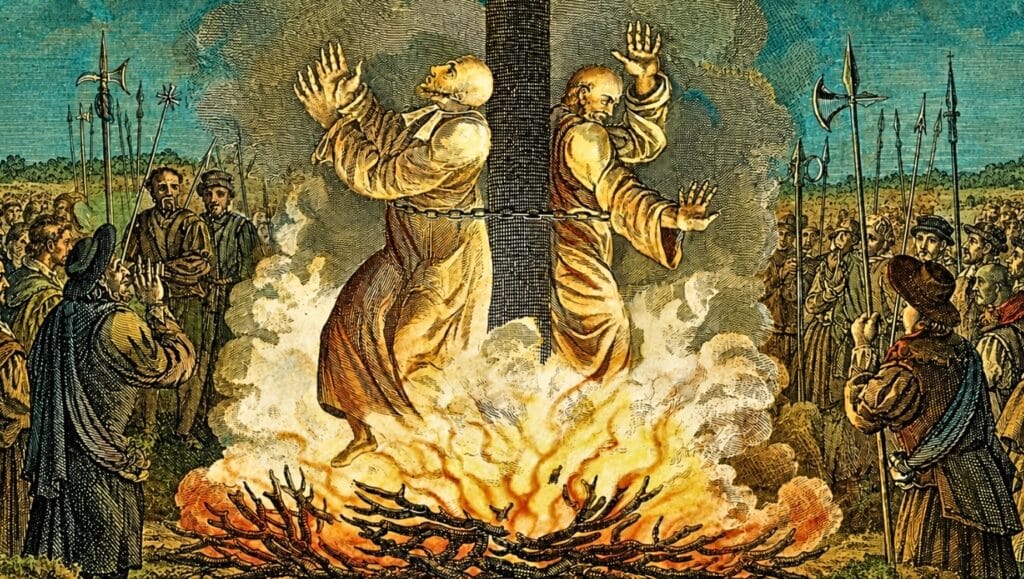
A Burning Candle: The Oxford Martyrs Latimer and Ridley
On October 16, 1555, in Oxford, England, Hugh Latimer and Nicholas Ridley, bishops in the English Church, died as martyrs. Bound back-to-back, they were burned at the stake.

Going Back to Church for Christmas Eve
“Its been a while. Going to the Christmas Eve service seems like the right thing to do. For the kids. For me. For God.” “Its been a while since I’ve been to church, and I’m not sure how I feel about going back. I’m not sure if I’ll feel good or guilty. Not sure if…
