The Church Calendar: A Rookie Anglican Guide to the Christian Year
What time is it? At first glance, it might not seem like it, but this is one of the most important questions a human being can ask! Thankfully, there’s an Anglican answer! Or, better, there is a Christian answer that the Anglican tradition helps proclaim!
While the secular calendar organizes life around civic holidays, national events, school schedules, and personal anniversaries, the Church Calendar organizes life around the saving acts of God in Jesus Christ. Year after year, it leads Christians through the events of Christ’s life, death, Resurrection, ascension, and his promised return. Rather than treating these as historic moments, however, the Church invites believers to inhabit them, allowing that Gospel story to shape our rhythms of worship, prayer, and Scripture proclamation.
Sponsored
Keeping Sacred Time: The Liturgical Year
Whereas many world religions seek salvation as an escape from time, Christianity proclaims salvation as a redemption of time (see Alexander Schmemann’s For the Life of the World, 47-48). Keeping sacred time did not begin with the Christian movement, however, for the Church calendar traces its origins to the principal feasts of Judaism:
- The Feast of Unleavened Bread (Passover; Deut. 16:1-8),
- The Feast of Weeks (Pentecost; Deut. 16:9-12), and
- The Feast of Booths (Deut. 16:13-17).
Look carefully then how you walk, not as unwise but as wise, making the best use of the time, because the days are evil.
Ephesians 5:15-16
To commemorate God’s redemptive acts and continual blessings, these three feast days required special worship at the temple in Jerusalem. According to Christians, however, the redemptive acts of God commemorated in Judaism find their fulfillment in God’s invasion of and triumph over time through Jesus Christ.
Much like the gospel the Church proclaims, the calendar the Church keeps revolves around these two divine movements, the invasion of the Incarnation, and the triumph of the Resurrection. Remember the former through the Christmas cycle, from Advent until Lent, and the latter through the Easter cycle, from Lent until Pentecost (Mitchell, “Sanctifying Time: The Calendar,” in The Oxford Guide to the Book of Common Prayer, 476-477).
The Incarnation (Christmas Cycle): from Advent to Lent
Advent
The Church year begins with Advent. This season encompasses four weeks of preparation. First, we await Christ’s second advent to judge the living and the dead (2 Pet 3:11-14; 1 John 3:2-3), but we also celebrate his first advent at the Incarnation. Just as the Israelites awaited a Messiah to fulfill God’s promises from Genesis 3:15 to Jeremiah 31:31-34 and beyond, so Christians await the return of Jesus the Messiah to renew all things (Rev. 21).
Christmastide and Epiphanytide
Christmastide begins with the Nativity of Our Lord Jesus Christ on December 25. It extends for twelve days of celebrating the Incarnation (John 1:17). Epiphanytide begins with the Epiphany of Our Lord Jesus Christ on January 6, and extends to the Presentation of Our Lord Jesus Christ in the Temple (Luke 2:22-52) on February 2. This season commemorates the revelation of Christ to the Gentiles in fulfillment of prophecy (Isa. 60:1-3), as exemplified in the visitation of the Magi.
The Resurrection (Easter/Paschal Cycle): from Lent to Pentecost
Lent and Holy Week
Just as the Christmas cycle begins with a season of preparation, so the Paschal cycle begins with Lent—the period of fasting and penitence from Ash Wednesday until Holy Saturday. Because Lent lasts for forty days, not counting the six Sundays which are celebrations of the Resurrection, it recalls Christ’s fasting during temptation in the wilderness (Mt. 4:1-11). The last week of Lent, Holy Week, remembers the last week of Christ’s earthly life, beginning with Palm Sunday’s commemoration of Jesus’s triumphal entry into Jerusalem (Mt. 21:1-11).
The Triduum (“Three Days”)
The Paschal Triduum (“three days”) begins on the evening of Maundy Thursday and lasts until evening on Easter Sunday. It includes:
- Maundy Thursday commemorates the institution of the Eucharist at the Last Supper (Mt. 26:20-35) and Christ’s washing of the disciples’ feet (John 13:1-15).
- Good Friday, a commemoration of the Crucifixion (Mt. 27:27-54.)
- Holy Saturday, remembering Christ’s time in the tomb and his descent into Hades. (1 Peter 3:18-20).
- Easter Sunday, which celebrates the triumphal Resurrection of Christ from the dead (Mt. 28:1-20).
Eastertide
Eastertide then lasts for fifty days—first for forty days until the remembrance of Christ’s Ascension to the Father’s right hand (Acts 1:1-11), and then for ten more days until the commemoration of the Holy Spirit’s descent at Pentecost (Acts 2:1-41). This season emphasizes the typological fulfillment of the feasts of Unleavened Bread and Weeks in the Christian celebrations of Easter Sunday and Pentecost (Daniélou, The Bible and the Liturgy, 339).
“Ordinary” Time: The Season after Pentecost
The time between Trinity Sunday (the Sunday after Pentecost, focusing upon the Triune identity of God) and Christ the King Sunday (the Sunday before Advent, proclaiming Christ’s Lordship)—from approximately June through November—is called, alternately, Trinitytide, the Season After Pentecost, or Ordinary (numbered) time.
This remainder of the liturgical year is, in the words of Simon Chan’s Liturgical Theology, “the time in which the church is to live out its calling in the world, fulfilling the mission of God” (164). Instructed in the school of sacred time, Christians go forth to love and serve the broken world which God has invaded, and over which He triumphs.
Image: Old window and clock, York, UK. Photo by Bara7, courtesy of Getty Images, via Canva. Digitally edited by Jacob Davis.
Published on

The Calendar of Saints: A Rookie Anglican Guide
Anglicans celebrate feast days for saints to honor exemplary Christian lives, rooted in biblical teachings on imitation. This practice evolved from early church commemorations of martyrs like Polycarp. While Reformation efforts simplified the calendar, Anglicans now recognize both historical and contemporary figures, maintaining focus on Christ as the central figure in worship.
The Annunciation: A Rookie Anglican Guide
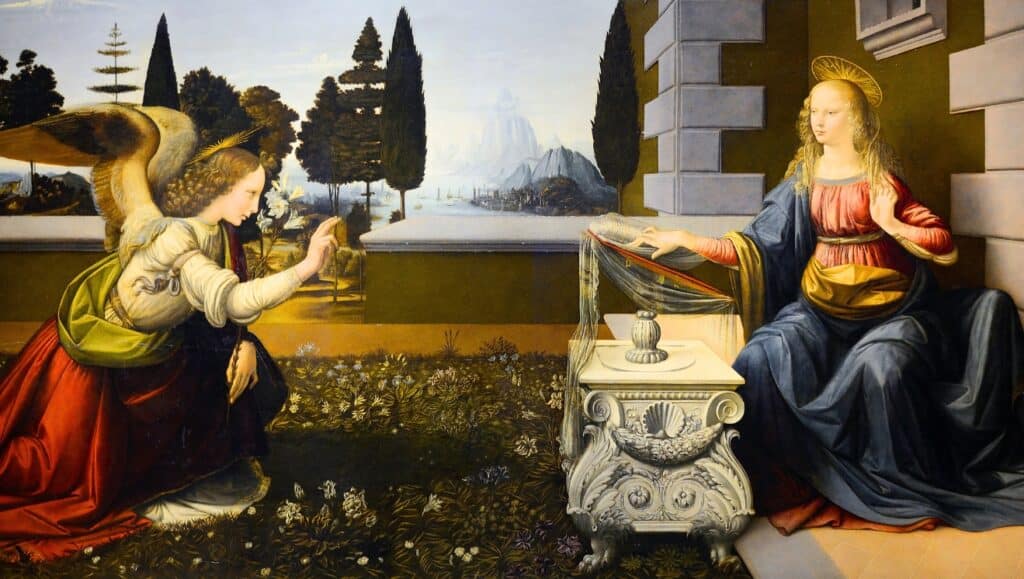
The Annunciation refers to the conception of Jesus by the Holy Spirit in the Virgin Mary and the announcement of this pregnancy by the angel Gabriel to Mary. The Church celebrates the feast on March 25, which is easy to remember when you realize it is precisely nine months before Christmas! This day reminds us…