

We Believe: God from God, Light from Light, True God from True God, Begotten, Not Made
In 1994, my sister died from heresy. That’s not hyperbole. It’s not a metaphor. It’s the plain truth. Leslie had contracted HIV from a botched artificial insemination procedure in the late 1980s. She kept it hidden from most everyone, and in the secrecy of her illness, she searched desperately for healing. Leslie tried everything—strict diets, supplements, experimental treatments. She lost weight, muscle mass. She lost hope.
Eventually, she encountered a man in Mesa, Arizona—a self-proclaimed doctor who claimed to have discovered something he called orbitally rearranged iridium. He sent her home with a vial of liquid and a syringe. She injected herself. Minutes later, she slipped into a coma and never woke up. Six weeks later, she died. It nearly killed our mother from grief.
Sponsored
But I say again: Leslie died of heresy.
Not only the heresy of pseudoscience, but the deeper, deadlier heresy of theological error. She believed Jesus was just a man. A good man. A philosopher. A moral teacher, perhaps a miracle worker back in the day. But not God. He couldn’t be.
And if Jesus is not God, then he cannot save. There is nothing transcendent. Nothing divine to trust. Nothing eternal to hope for. So, when faced with her mortality, she did what all people must do when they believe they are alone: she tried to save herself.
And that is what heresy does. It doesn’t just mislead the mind—it leaves the soul defenseless. Panicked. Without hope.
Why the Nicene Creed Matters
That’s why the Nicene Creed matters—not just historically, but eternally. In 325 A.D., when bishops from across the Christian world gathered at Nicaea, they were not playing word games. They were confronting the same danger my sister faced: a Jesus who was less than God.
As the historian Jaroslav Pelikan wrote, the creeds of the Church treat doctrine with the utmost seriousness “as quite literally a matter of life and death, both here in time and hereafter in eternity.”
So, the bishops answered Arius not with compromise, but with clarity:
We believe in one Lord, Jesus Christ, the only Son of God,
eternally begotten of the Father,
God from God, Light from Light, true God from true God,
begotten, not made, of one being with the Father.
These phrases may sound poetic, but they were a line in the sand.
Why “Begotten, Not Made” Matters
The Creed’s insistence that the Son is “begotten, not made” safeguards one of the most vital truths of the Christian faith: that Jesus is not a product of God’s will, like the stars, oceans, or creatures. He is not part of creation. He is of one being with the Father—equal, eternal, and divine.
To be begotten means to share the same essence. A carpenter makes a chair; a father begets a son. A potter forms a clay vessel; a mother gives birth to a child. One creates something other than themselves. The other brings forth one of the same nature. So it is with Jesus: He is begotten, not made—true God from true God.
And His begetting is eternal. It did not happen within time. There was never a moment when the Son was not. He is not a junior partner in the Godhead, nor a celestial delegate sent on assignment. He is, as John’s Gospel declares, the Word who was with God and was God from the beginning.
The language stretches us; it holds the language to explain our salvation. Hebrews 2:11 has this arresting phrase found in the Jerusalem Bible:
For consecrator and consecrated are all of the same stock.
Hebrews 2:11 (JB)
This means that the one who died for us and those for whom he died are of the same nature!!
If Christ were not fully God, the cross would be emptied of its power. And if he were not fully man, the cross could not reach us. Only the eternal Son, truly divine and truly human, can bridge the gap between God and humanity and bring peace.
Light from Light
We sometimes think of the ancients as simplistic, limited in vocabulary or concept. But the framers of the Creed were anything but. They were inspired. The phrase “Light from Light” is not only poetic—it is theological genius.
Faced with the rising threat of Arianism, the early Church needed language that would assert the full divinity of the Son without sliding into polytheism. They turned to the image of light (John 1:4-5; Hebrews 1:3), which was perfect.
In him was life, and the life was the light of men. The light shines in the darkness, and the darkness has not overcome it.
John 1:4-5
He is the radiance of the glory of God and the exact imprint of his nature, and he upholds the universe by the word of his power.
Hebrews 3:1
Light from light affirms that the Son shares the same divine essence as the Father. Light from a flame is not inferior or separate from the flame—it is the same light, the same fire, the same radiance. Equal, co-eternal, indivisible. Not subordinate. Not “lesser.” The Father and the Son are consubstantial—of one being.
“Light from Light” reinforces what the Creed proclaims in “begotten, not made.” It is a radiant declaration of the Son’s eternal relationship with the Father—a truth not just to be explained, but to be worshipped.
The Creed is an Anchor
We should not recite the Nicene Creed casually or memorize it like a school pledge. It should be spoken line by line, slowly, as though our lives depend on it—because they do. Every word was chosen to confess what God has revealed in Scripture, not explain it away. The Creed does not invite us to master a mystery but to be mastered by it.
We are not meant to embrace the Creed. We are meant to be embraced by it, like gravity. Mysterious, unyielding, and essential. It holds us even when we forget it’s there.
That’s what my sister needed. Not a theory or a supplement or a syringe. She needed something eternal to cling to when her strength failed.
Would Leslie Have Lived If She Believed the Creed?
I believe so.
She might not have been cured. But she would have been healed.
If she had believed in the God of the Creed, the eternal Son, uncreated and incarnate, she would have known she wasn’t alone. She would have trusted in his power to save and in his willingness to hold her, even in death. She would have turned not inward in desperation, but outward in surrender. And perhaps that surrender would have spared her from the quackery that took her life. But even if it hadn’t, she would have fallen, not into fear and to her death, but into the everlasting arms of Christ.
This is why doctrine matters and why the Creed is not optional.
This is why we preach Christ—eternally begotten of the Father, God from God, Light from Light, true God from true God, begotten, not made, of one being with the Father.
Because anything less than that is not the gospel, it’s just another dead-end street, dressed in spiritual language, but empty of life.
Image: Photo by Nejron, courtesy of Canva. Digitally edited by Jacob Davis.

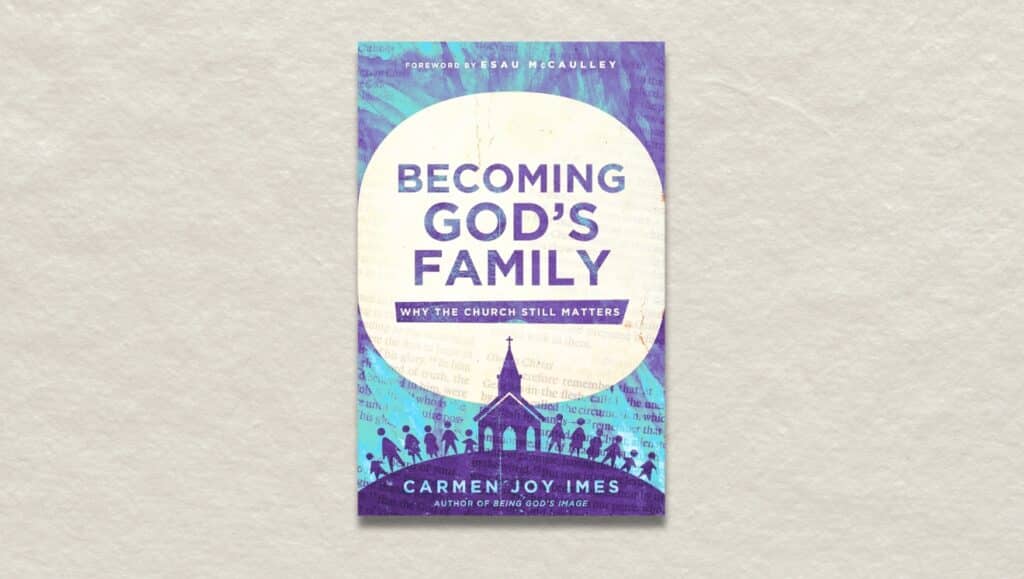
Book Review: Becoming God’s Family by Carmen Joy Imes
In Becoming God’s Family: Why the Church Still Matters, Dr. Carmen Joy Imes invites readers to rediscover the beauty of life together as God’s people.

The Bible: Believing God’s Word Written (Jerusalem Declaration 2.1)
Clause 2 has two sentences. Taken together, they capture the twofold dynamic of the Bible, moving from God’s gracious self-revelation to our thankful response.
