

What are the Fundamental Declarations of the ACNA?
What is fundamental? Christians should ask themselves this question, because what we hold as fundamental defines our core convictions, timeless truths, and essentials. The Anglican Church in North America defined these at its formation as the Fundamental Declarations. These seven statements are enshrined both in Article I of its Constitution and printed on pp. 766 and 767 in the Documentary Foundations section of the 2019 Book of Common Prayer.
What do ACNA clergy and laity hold as fundamental? The declarations begin with an opening paragraph that anchors our identity as “being a part of the One, Holy, Catholic, and Apostolic Church of Christ” and roots our faith by confessing “Jesus Christ to be the Way, the Truth, and the Life: no one comes to the Father but by Him.” We learn that the ACNA is not separating from the church catholic but belongs to it precisely because she professes and confesses the ancient faith built upon Christ alone.
Sponsored
What is the Anglican Way?
The ACNA identifies “the following seven elements as characteristic of the Anglican Way,” and they are a concise theological summary for anyone curious about Anglicanism.
Word
First, the Old and New Testaments are “the inspired Word of God,” and therefore trustworthy in “containing all things necessary for salvation, and to be the final authority and unchangeable standard for Christian faith and life.” Anglicans are under the authority of Holy Scripture, and where it speaks, God has spoken, and we trust and obey.
Sacrament
Second, we are anchored in the “Baptism and Supper of the Lord” that were “ordained by Christ Himself” as the Gospel sacraments that must “be ministered with unfailing use of His words of institution and of the elements ordained by Him.” We enter into the Church, the Body of Christ, through the waters of baptism and in the Triune Name, and we feast upon Christ through the consecrated bread and wine. Replacing the elements is not an option, because we are under Christ’s authority in His inspired Holy Scriptures.
Episcopacy
The first two points emphasize Word and Sacrament; the third adds a distinctively Anglican conviction: “the godly historic Episcopate as an inherent part of the apostolic faith and practice, and therefore as integral to the fullness and unity of the Body of Christ.” In charity, we do not “de-church” Christians without the historic episcopate, but in clarity we proclaim a lack of fullness without it, based upon the ancient faith and early tradition recorded in the Scriptures and the earliest Church Fathers.
Creeds and Councils
The declarations then turn to the wider Church’s confession. In point 4, ACNA receives and confesses the catholic creeds proven by Holy Scripture (there’s point 1 again!) from the undivided Church. Those creeds are the Apostles’ Creed—used typically at baptism and the daily office; the Nicene Creed—used at Holy Communion; and the Athanasian Creed—the great Western summary of the doctrine of the Trinity, used on Trinity Sunday and thirteen times a year in the 1662 Book of Common Prayer.
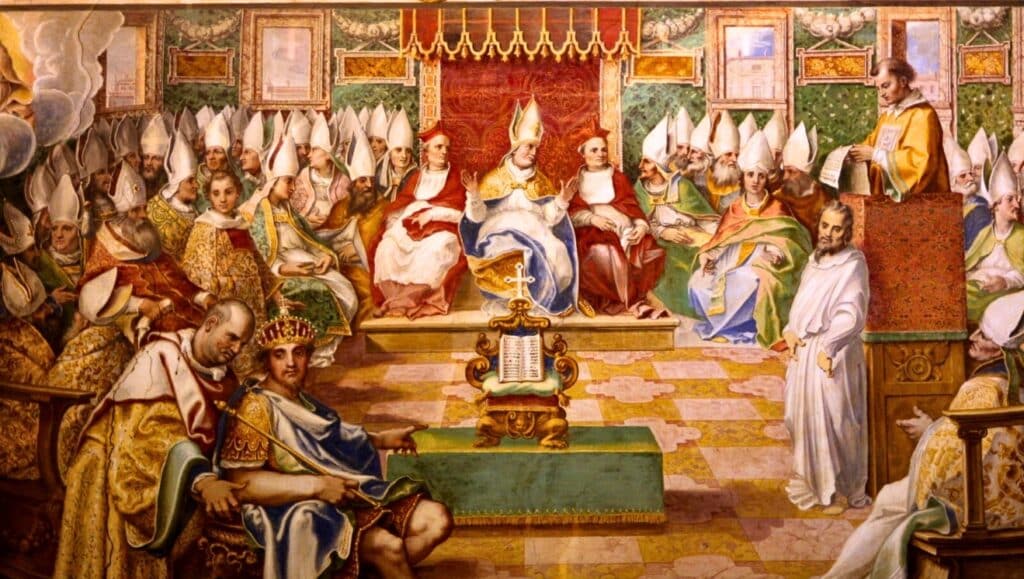
Point 5 introduces us to the seven great “Councils of the undivided Church,” commonly called the ecumenical councils. Christians still debate which councils count and how many qualify as ecumenical. ACNA conservatively affirms “the teaching of the first four Councils,” as St. Gregory the Great did. Those first four poetically remind us of the pillars that are the four Gospels. However, ACNA receives the latter three Councils from the undivided Church (before East and West split into Eastern Orthodoxy and Roman Catholicism) for their “Christological clarifications … in so far as they are agreeable to the Holy Scriptures.”
Once again, ACNA is faithful to the Holy Scriptures above all else, while receiving the ancient doctrines of the undivided Church.
Formed by the Formularies
From these ancient foundations, ACNA turns to the Anglican Formularies.
The Prayer Book and Ordinal
Point 6 establishes the 1662 Book of Common Prayer and the Ordinal attached, “as a standard for Anglican doctrine and discipline.” This traditional prayer book serves as a guide and north star (along with the prior Fundamental Declarations) in understanding doctrine and administering discipline within the Church. However, our worship is not locked into the 1662 liturgies, as Anglicans worldwide have adapted them locally. Therefore, “the Books which preceded it,” that is, the 1549, 1552, and 1559 editions, are “the standard for the Anglican tradition of worship.” In other words, our worship does not submit to a rector’s individual preferences or cultural fads, but follows and reflects the ancient worship of English-speaking Christians for centuries.
The Thirty-Nine Articles
Alongside the Prayer Book, point 7 receives “the Thirty-Nine Articles of Religion of 1571… as expressing fundamental principles of authentic Anglican belief.” The Articles of Religion are authoritative in ACNA; however, certain disputes with Rome have changed as Rome has changed. For example, Rome worships in the vernacular.
Therefore, charitably, the ACNA notes the Articles are “expressing the Anglican response to certain doctrinal issues controverted at that time.” How should we read them today? The ACNA borrows language from King Charles I’s preface and explains that readers should take them “in their literal and grammatical sense,” in addition to rooting them in the controversies between the Church of England and Rome during the Reformation.
Context is king, yet context does not make them irrelevant, for ACNA proclaims them within the Fundamental Declarations as “expressing fundamental principles” for anyone who claims to uphold “authentic Anglican belief.”
Conclusion
The Fundamental Declarations end where they began. The final paragraph explains “by the help of God to hold and maintain, as the Anglican Way has received them,” these seven points. ACNA seeks to uphold the Christian faith in its entirety, namely “the doctrine, discipline and worship of Christ and to transmit the same, unimpaired, to our posterity.” ACNA calls itself to reach North America with the Gospel, from our children to our neighbor. It seeks unity globally with fellow Anglicans, insofar as those who fly under the tribe Anglican will “hold and maintain the Historic Faith, Doctrine, Sacraments and Discipline of the One, Holy, Catholic, and Apostolic Church.”
Therefore, take up and read the Fundamental Declarations and remind yourself, or learn for the first time, what Anglicans in North America believe. Allow these seven short points to serve as a guide for further study, beginning with Scripture, moving along the path of catholic and orthodox doctrine of old, and presenting themselves in the Anglican formularies distilled during the Reformation.
Want to learn more? The Ven. Andrew Brashier has written and published a whole book on the ACNA’s Fundamental Declarations, called An Anglican Anchor.
Image: Photo of St. Philip’s Church, Charleston, South Carolina. Photo and editing by Jacob Davis.

The Formularies: A Rookie Anglican Guide
The Anglican Formularies are the Thirty-Nine Articles, the Book of Common Prayer, and the Ordinal (the service for ordaining clergy). A strong case can be made that the Books of Homilies also serve this function. The Formularies provide both cohesiveness and clarity to the Church’s doctrine.
The Nicene Creed: A Rookie Anglican Guide
First drafted by bishops gathered at the Council of Nicaea in 325, the Nicene Creed is now affirmed by all major Christian denominations as a fundamental expression of the faith.
