
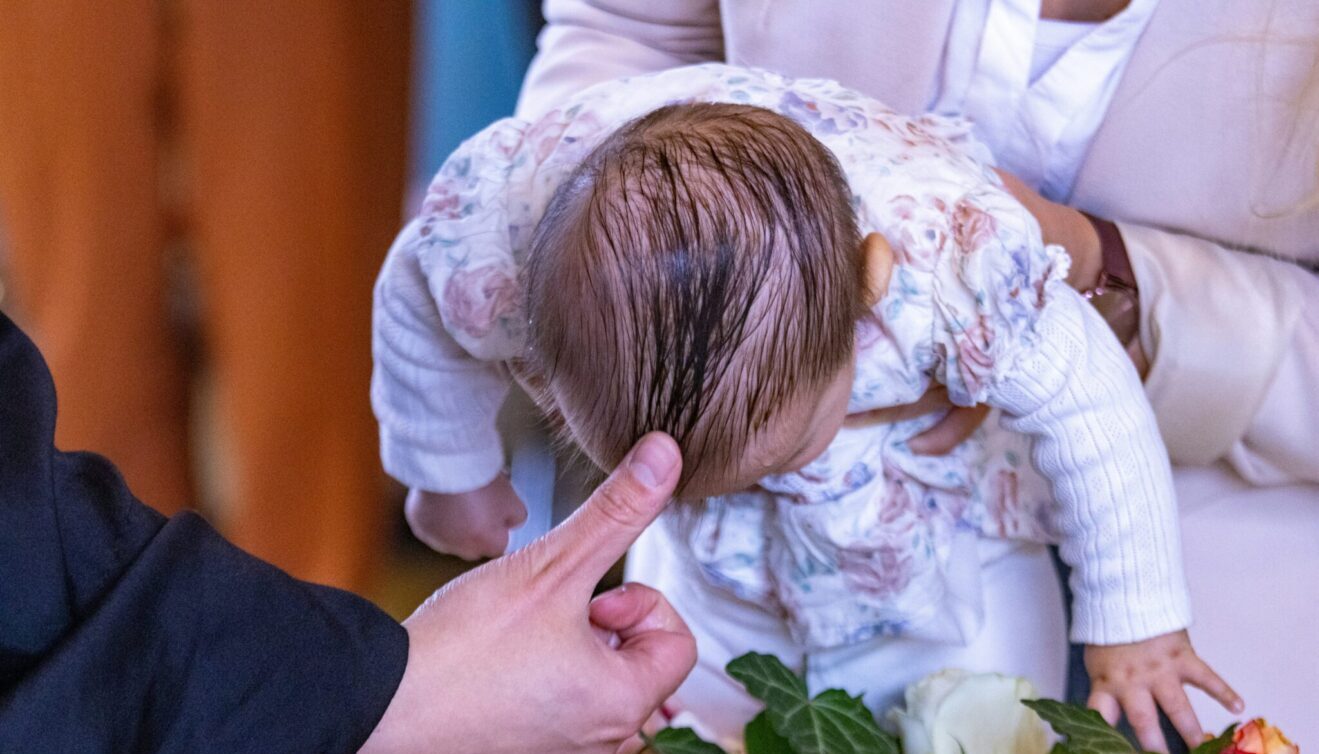
Infant Baptism: Why do Anglicans Baptize Babies?
Why baptize infants? The Anglican theme verse for children would have to be,
“Let the little children come to me and do not hinder them, for to such belongs the kingdom of heaven.”
Matthew 19.14
Starting very early in the life of the Christian Church, Christian children were seen as members of the covenant community of faith. Just as Israel brought their sons to the sign of the Covenant, circumcision, we bring our children to the sign of the New Covenant, called Baptism (see Colossians 2:11-13).
Sponsored
We, therefore, treat our children as Christians, teaching them from the beginning how to live as a member of the Body of Christ, and not withholding from them any grace they need through Christ to grow into that faith. In other words, we believe we are “letting them come to Jesus” as he commanded.
St Peter, preaching the Gospel to the people, says,
Repent and be baptized every one of you in the name of Jesus Christ for the forgiveness of your sins, and you will receive the gift of the Holy Spirit. For the promise is for you and for your children and for all who are far off, everyone whom the Lord our God calls to himself .
Acts 2.38-38
During the Reformation, all of the leading Reformers retained infant baptism, a shocking fact for many American Protestants today.
Martin Luther looked at it this way,
Since our baptizing has been thus from the beginning of Christianity and the custom has been to baptize children, and since no one can prove with good reasons that they do not have faith, we should not make changes and build on such weak arguments. For if we are going to change or do away with customs that are traditional, it is necessary to prove convincingly that these are contrary to the Word of God.
Concerning Rebaptism, pg. 353
John Calvin followed Augustine in viewing paedobaptism as an acknowledgment of original sin and absolute grace. The helpless baby reminds us that we are all like infants in God’s presence. The Reformer writes,
“Cornelius, though already graced by the Spirit, was baptized for remission of sins, not for fuller forgiveness, but for surer faith… Ananias told Paul to be baptized to be assured of forgiveness, not that baptism itself washes away sins… We gain nothing from baptism without faith… Baptism testifies our confession of faith in God’s mercy and our purity through Christ’s forgiveness… We are baptized by one Spirit into one body.”
John Calvin, Institutes of the Christian Religion, Bk. 4, Ch. 15, pg. 521
The Thirty-Nine Articles remark,
XXVII. Of Baptism
Baptism is not only a sign of profession, and mark of difference, whereby Christian men are discerned from others that be not christened, but it is also a sign of Regeneration or new Birth, whereby, as by an instrument, they that receive Baptism rightly are grafted into the Church; the promises of forgiveness of sin, and of our adoption to be the sons of God by the Holy Ghost, are visibly signed and sealed; Faith is confirmed, and Grace increased by virtue of prayer unto God. The Baptism of young Children is in any wise to be retained in the Church, as most
agreeable with the institution of Christ.
Leaving the Reformed for the Remonstrant side of the Protestant family, we notice John Wesley favored baptizing infants.
“Infants are born with original sin, making them liable to damnation. … Baptism is the ordinary means God has appointed to cleanse them from this sin. … While exceptions may exist, this generally applies.”
“Wesley, John. Treatise on Baptism. 1756 ed. 1756. p. 193. [Available at: https://wesleyscholar.com/wp-content/uploads/2021/12/JW-Treatise-on-Baptism.pdf]
The Undivided Church and the Reformers believed that helpless infants were proper candidates for baptism. The tradition does not usually align along those lines. Virtually all Christians have believed that children of Christian parents should be baptized. The Bible does seem to command it since Peter said Baptism was “for your children.” Jesus warned us not to keep the children from him.
Baptism, which corresponds to this, now saves you, not as a removal of dirt from the body but as an appeal to God for a good conscience, through the resurrection of Jesus Christ,
1 Peter 3.21
Photo by Marek Studzinski on Upsplash


Anglicans, Infant Baptism, and Believer’s Baptism: A Baptist Weighs-In (Opinion)
Editor’s note: As with all of our “Opinion” pieces, the following guest post does not represent an official position of Anglican Compass. With the Thirty-Nine Articles of Religion, Anglican Compass believes that “the Baptism of young Children is in any wise to be retained. in the Church, as most agreeable with the institution of Christ”…

Holy Baptism: A Rookie Anglican Guide
The baptized receive regeneration, the forgiveness of sins, and adoption as children of God and members of the covenant. Both infants and adults, upon being baptized, are made members of the Covenant of Grace.
