Are Anglican Churches Biblical, “Bible Churches”?

For many years, I attended a church that called itself a “Bible church.” I really loved it and am thankful for everything I received there. But many years later I started to reflect on what exactly that name means.

What does it mean to claim that your church is biblical, a “Bible church”?

First of all, it (at least implicitly) means that churches unlike your own are in fact not biblical.

That is a strong claim to make.
Sponsored

What do we actually know about the churches in the Bible?

  • We know they had a number of leadership positions, from apostle to deacon, teacher to prophet, and so on.
  • We know they sung hymns.
  • We know they practiced baptism for the dead, though we don’t know what exactly what means nor do we know if it was a good thing or not.
  • We know they shared agape feasts on a regular basis.
  • We know that many of them met in homes.
  • We know some of the basic creedal formulas that they likely recited on a regular basis and memorized.
  • We know that they used their resources to help widows and Christian women who had decided not to marry because of their faith in Christ (ie, nuns).

As it happens, no “Bible church” actually does all these things. Indeed, most Christian churches don’t do all these things, but then again, they don’t make the claim that they are, in fact, Bible churches.

(To read more about “traditions that are not in the Bible,” click here.)

Second of all, it means that there is such a thing as a “Bible” church.

But the reality in the New Testament is quite a bit more complicated and, I think, interesting.

Jerusalem Bible Church, under the leadership of James, had ways of interpreting Scripture and living the Christian faith that were quite different from those of Antioch Bible Church—a veritable multisite megachurch with a strong focus on sending out missionaries (like Paul, among others). And then there’s Corinth Bible Church—an inclusive and diverse community of Spirit-filled disciples, where the leadership of the youth was affirmed and valued!

(On that last point, see the letters from Clement of Rome to Corinth. Recall that Clement, the senior pastor of Rome Bible Church (AKA, one of the earliest popes), was possibly a companion of Paul.)

So we have to ask the question, is there such a thing as a ‘Bible’ church—simpliciter, without qualification? I think the answer must be no.

Third, it strongly implies that being a “Bible” church is actually a good thing.

Let’s go back to Corinth Bible Church above. Any of you, my fellow pastors, feel like accepting that call?

The reality is that the Bible’s churches were much like our churches today: excelling in certain and things and struggling greatly with others. Some had great strengths while also having great weaknesses.

You know the problems: lukewarm faith, wanting to return to the good old days (think of the Judaizers), attraction to the latest cool new thing for a spiritual breakthrough (Gnostics, though I think here of evangelical fads like the Prayer of Jabez—but at least that is actually from the bible). Keeping Christ to yourself because, well, you know, people might get offended. And many more.

If you have ever pastored or attended a church with any of these issues—and there are many more—then that was a Bible church.

Finally, I must say it, a “Bible” church would actually not have the New Testament.

Take a moment and let that sink in. The earliest churches may have had parts or all of the Tanakh (the Old Testament, roughly speaking). But they had no New Testament.

Bible churches would have likely had a box with various scrolls or parchments that had parts or all of books in our present-day New Testament, along with numerous other documents (like those letters from Clement to Corinth).

The writings read and taught on in one city would have overlapped with those of other cities, but would not have been identical at all. The New Testament was not codified as a universal collection of documents (canon) until the fourth century.

So there is a fundamental irony in being a “Bible church”: these churches actually predate the Bible we use today!

(To learn more about reading Scripture in Anglican worship, click here.)

But Shouldn’t We Be Biblical?

I can hear the objections: “That’s not what we mean. We mean that we follow the Bible and only the Bible.”

I would say go back to point one above: if you own property you are not a Bible church. If you do not meet in homes or the (presently non-existent) Temple in Jerusalem, you are not a Bible church. You get the idea.

Now, Anglicans certainly agree that all that is needed for salvation is found in the Bible. We claim that the Word of God must be proclaimed rightly for any congregation of people to really be a church. And we firmly commit ourselves to the foundational biblical teachings and recite this summary on a regular basis in the form of the Apostles’ Creed.

But there is more good news from the Anglican side. It’s OK!

It’s OK that your church today does not function exactly like one of the Bible’s churches.

Just as God rejoiced in the variety of life as it flourished and so blessed it in Genesis 1, just as God did not want for humanity to all be uniform and resisted their efforts at such an endeavor at the Tower of Babel, so God is OK with the variety in our forms of worship and being his Church.

(Click here to read “Anglican Worship: Where Does It Say in the Bible to Do That?“)

Obviously we at Anglican Pastor believe there is much to commend to you in the broad and varied traditions of the Anglican way. But we do not claim that somehow we are the only ones doing it right (biblically), and that everyone else is somehow not.

While not claiming to be the biblical way, we strive to be a biblical way.

While not claiming to be the true Church, we strive to be among those churches that are faithful and true.

And, as a final, parting point, let me say something about albs.
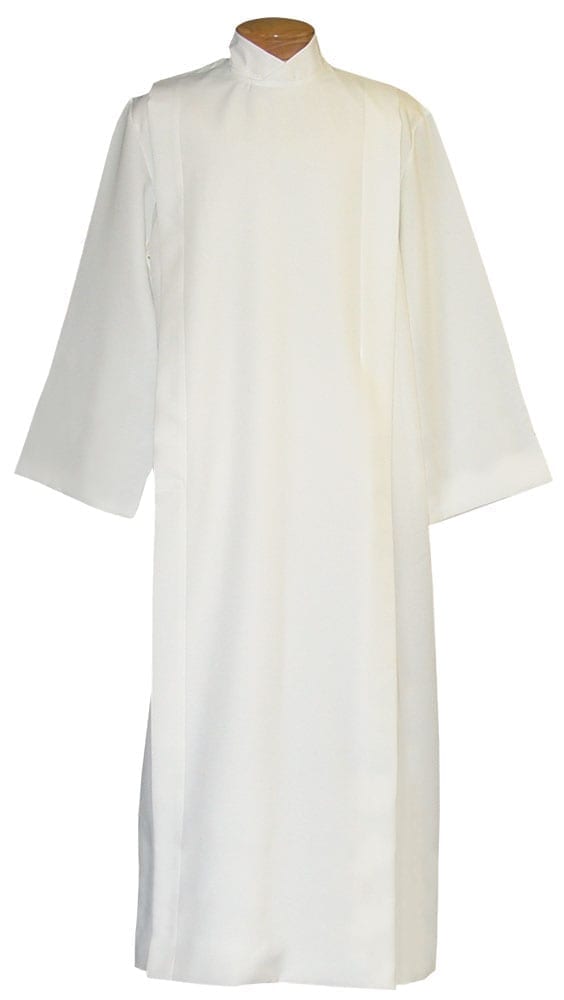
The white robe called the alb is indeed what your brothers at Rome Bible Church wore on a daily basis.

So, if you’re a pastor of a “Bible church,” then lay aside your suit (or shorts, skinny jeans, and/or graphic T) and get yourself an alb. And then, when people are like, “That looks so Catholic!,” you can reply: “I got this style from Pastor Clem at RBC.”

Watch out, you just might start a trend.

(To learn more about Scripture in the Anglican tradition, click here.)

Published on

July 29, 2019

Author

Duane Miller

The Rev. Dr. Duane Miller serves as priest at the Anglican Cathedral of the Redeemer, associate professor at the Protestant Faculty of Theology at Madrid, and founding co-pastor at Kanisa, an Arabic-language Christian fellowship.

View more from Duane Miller

Comments

Please comment with both clarity and charity!

Subscribe to Comments
Notify of
8 Comments

I can hardly believe what I just read. I thought the theme of the article was going to be about how Anglican churches are biblical. Instead waits an attack on churches that go by the name “Bible church” that is way off base.

The article went downhill quickly when it made its first major assertion that to claim to be a Bible church means that “churches unlike your own are in fact not biblical.” Now, there may well be people attending Bible churches who are convinced that they have the truth and other Christians are missing out. But there are Anglicans who have that same kind of attitude! I have been part of Bible churches, and they never claimed to be doing church exactly the way people in the New Testament did. The writer got it right towards the end when he quoted some hypothetical person as saying “we follow the Bible and only the Bible.” That’s the point: the Bible is the source of authority, and much time is invested in studying the Bible. They study it closely enough, in fact, to understand that we don’t do things exactly as they did in the first century.

This article could have been a good one if it emphasized the significance of the Bible in Anglican churches. Instead, the writer chose to put up a yet another fence between Christians by erecting a straw man and then knocking it down, and all (apparently) in an attempt to justify what Anglicans do. There is an unnecessary defensiveness here. In a day when Christians have become the minority and are finding ourselves on the defensive for what we believe and do, the last thing we need to be doing is marking off boundaries between our traditions and lobbing grenades at the other side. If the writer is going to offer criticisms of Bible churches, at least he should get what they believe right, and only then offer friendly, constructive criticisms.

Some years ago the leadership of the magazine Touchstone put on a conference in Illinois called “Christian Unity and the Divisions We Must Sustain” (this was in the time of the Evangelicals and Catholics Together project). The main theme of the conference was that there are and will be distinctions between Christian traditions, but we need to see where we can come together for the sake of the gospel. I invite the Anglican Pastor to join in that project.

My initial response was disproportionately long. Not everything one thinks about a matter needs to be put on paper, as it were. I would have shortened my comment except that there is no way I have found to do that. So I apologize for taking up so much space.

I have to think that this is a troll. If it was meant to be provocative, it certainly succeeded. Personally, I think the innovations of the ACNA in their new book are not something I support, because I am completely in the 1928 BCP camp. If the writer’s attempt is to point out the mote in the eye of the neighbor rather than the beam in his, then I would think he has succeeded. Had the writer pointed out the strong scriptural basis of traditional Anglicanism, I think we could agree that we are very scriptural in whatever branch we are in: I don’t get the point of this article on an “Anglican” web site.

I’m surprised that some took offense and assumed ill will on the part of the writer. I am currently a member of a Bible Church and the claim is often made that they are doing things like the 1st Century Church. There IS a subtle implication that other churches are not doing things the “right” way. Some individuals in this congregation are very adamant about it and others like myself have a more ecumenical view. I thought the piece did a great job of using a little humor to explain to those in the Bible / Evangelical crowd where they may not be as Biblical as they think they are and where other more historically grounded traditions are coming from.
I’m very thankful for finding an excellent Anglo-Catholic parish that does We’d AM said mass and I’ve learned a lot about Church History over the past decade, but a lot of my learning has been online and I’ve had to sift through some nasty accusations. I appreciate a writer that takes a risk at writing something that is fun as well I formative. I understand that humor is a tricky thing, but I found the humor in this to be from a gentle, “have you considered” type of place and not a I’m right and you’re wrong kind of place.
I do think there’s some validity in the critique of the title. I was expecting something slightly different. Sometimes you need a title that will interest folks enough to read.

[Please excuse typos and other errors, posting from a phone]

Whoah now, there was absolutely no baptism of the dead going on in first century Christianity. Paul in his epistle to the Corinthians was referring to a pagan practice in Corinth (baptism in and of itself was common to the first century world), not something done by followers of the Christ. This is egregiously misleading, and might even lead astray those in the LDS who erroneously believe that this was a first century practice.

Furthermore, the ambivalence of this post towards orthodoxy is shocking. While we Anglicans do not claim to be the one true church (such is wherever the Sacraments are rightly administered and the Gospel proclaimed), I cannot in good conscience let someone with your level of authority, Señor Miller, affirm the orthodoxy of communism, endorse the laissez-faire ecclesiology and theology of Christ’s church, and sow confusion on the canon of the Scriptures, which was far more cohesive than you suggest. Our articles place strong parameters on what is a church and what is not, what is biblical doctrine and what is not. There is room for disagreement where the articles are silent, but to 1) disregard Article XIX which literally defines what a Biblical church is, 2) to gloss over Article XX which tells us the authority of that church, and 3) to ignore Article XXXIV which encourages conformity to the tradition from whence the church came, is to reject the essence of what makes us as Anglicans who we are.

I think/hope you were trying to show there’s not just one external way to conform to the principles found in Scripture, but it sounds a lot like you don’t believe it matters how believers worship, what they do, or what they believe. That is not orthodox Christian view on doctrine, worship, or life. You should defend Anglicanism like it has always been courageously defended by men like Cranmer, Jewel, Hooker, and Ussher: by constructively using the Scriptures to show we are a truly biblical (and therefore catholic) denomination, not by poking frivolous holes in “Bible” churches using poor historical research and equally poor biblical exegesis.

I mean no disrespect, but I cannot allow this to go unanswered, as if this were some sort of endorsed position within Anglicanism. I am currently working towards ordination, and articles such as this which write with such impunity towards God’s Holy Word grieve me as somebody who will be represented by these articles which do not recognize the perspicuity of Scripture or the honor of our tradition.

Apologies for incoherence or typos, I wish I had greater time to write a response.

Unfortunately, as previous comments reveal, we are unable to enjoy some playful banter between Christian brothers and sisters.

The tone of this article is so obviously not judgmental, but playful. “Bible” churches can be funny. Anglican men in fancy golden dresses and headgear prancing about in clouds of incense, thinking this is what it means to be part of the apostolic church, is also funny.

Relax and go put on an alb.

Great article. Members of a Bible Church should not be offended. The point is simply that it would be extremely difficult and undesirable to 100% mimic the earliest churches.

a load of old codswallop!!
