The 2019 Book of Common Prayer: A Rookie Anglican Guide
In 2019, the Anglican Church in North America (ACNA) released its official edition of the Book of Common Prayer. As we explain in the Rookie Anglican Guide to the Book of Common Prayer (AKA “BCP”), the Book of Common Prayer is the comprehensive service book for Anglican churches (churches that trace their lineage back to the Church of England). The BCP contains the written liturgies for almost any service held at an Anglican church. These include:
- daily prayer services (the Daily Office)
- weekly worship (Holy Communion, AKA “Lord’s Supper” or “Holy Eucharist”)
- special services for Lent and Holy Week (like Ash Wednesday and Good Friday)
- ordination services (for a Bishop, Priest, or Deacon)
- services used to celebrate new ministries or churches (Institution of a Rector, Dedication of a Place of Worship)
- services held throughout one’s life (Baptism, Confirmation, Wedding, Funeral)
Most Books of Common Prayer also usually contain:

Sponsored
- a calendar to help you follow the Church Year
- prayers and thanksgivings that you use throughout the Church Year and/or at any time
- the book of Psalms (AKA the “Psalter”), because these get used a lot in Anglican worship
- a catechism and other documents to teach the basics of the Christian faith
- lectionaries, which let you know what passages of Scripture to read during all the services mentioned in the previous list
Why a New Prayer Book?
In June 2008, the leaders of the Global Anglican Future Conference (GAFCON) issued a statement containing the “Jerusalem Declaration.” Among other things, this statement called for “the formation of a province in North America.” One year later, in June 2009, the Anglican Church in North America (ACNA) held its first Provincial Assembly.
Ever since its birth, one of the ACNA’s goals has been to develop a new Book of Common Prayer—one that is closer to the tradition of the 1662 BCP than some other recent BCPs in use throughout the global Anglican Communion.
Concerning the importance of the 1662 BCP, read what the ACNA’s “Fundamental Declarations of the Province” has to say:
(6) We receive The Book of Common Prayer as set forth by the Church of England in 1662, together with the Ordinal attached to the same, as a standard for Anglican doctrine and discipline, and, with the Books which preceded it, as the standard for the Anglican tradition of worship.
p. 767
This is very much in line with GAFCON’s 2008 Jerusalem Declaration:
(6) We rejoice in our Anglican sacramental and liturgical heritage as an expression of the gospel, and we uphold the 1662 Book of Common Prayer as a true and authoritative standard of worship and prayer, to be translated and locally adapted for each culture.
p. 792
The 2019 BCP’s Formation
The Preface of the 2019 BCP, written by Archbishop Foley Beach and Archbishop Emeritus Robert Duncan, situates the ACNA’s new BCP within Anglicanism’s Prayer Book tradition. They pull no punches while taking issue with recent BCPs:
The liturgical movement of the 20th century and the ecumenical rapprochement in the second half of that century had an immense impact on the Prayer Book tradition. The Book of Common Prayer (1979) in the United States and various Prayer Books that appeared in Anglican Provinces from South America to Kenya to South East Asia to New Zealand were often more revolutionary than evolutionary in character. Eucharistic prayers in particular were influenced by the re-discovery of patristic texts unknown at the Reformation, and often bore little resemblance to what had for centuries been the Anglican norm. Baptismal theology, especially in North America, was affected by radical revisions to the received Christian understanding, and came perilously close to proclaiming a gospel of individual affirmation rather than of personal transformation and sanctification.
Pg. 4
According to Archbishops Foley and Robert, the 2019 BCP is a part of the 21st century’s “global reassessment of the Book of Common Prayer of 1662 as ‘the standard for doctrine, discipline, and worship” (p. 4). They conclude the Preface with the following words:
The Book of Common Prayer (2019) is indisputably true to Cranmer’s originating vision of a form of prayers and praises that is thoroughly Biblical, catholic in the manner of the early centuries, highly participatory in delivery, peculiarly Anglican and English in its roots, culturally adaptive and missional in a most remarkable way, utterly accessible to the people, and whose repetitions are intended to form the faithful catechetically and to give them doxological voice.
The Book of Common Prayer (2019) is the product of the new era of reform and restoration that has created the Anglican Church in North America. The Jerusalem Declaration of 2008 located itself within the historic confines of what is authentically the Christian Faith and the Anglican patrimony, and sought to restore their fullness and beauty. The Book of Common Prayer (2019) is offered to the same end.
pp. 4-5
If you’d like an even deeper dive into the history of the 2019 BCP’s development, you can read the following reports of the Liturgy Task Force:
How do you use the 2019 Book of Common Prayer?
So much for the motivations and history behind the 2019 BCP. How do you use the thing?
At this point, it’s important to remember that the BCP is designed to be a comprehensive resource. That means that, unless you’re Anglican clergy (and even then!), you won’t use the entirety of the BCP very often. Instead, you’ll come back to certain sections time and time again. And you’ll use others maybe once in your life! So, we’ll focus on the sections of the 2019 BCP that you’ll use most often.
First, get oriented to the Church’s worship.
Take a close look at “Concerning the Divine Service of the Church” on pages 6-8. It’s well worth your time, especially if you’re a newcomer to Prayer Book worship.
The following are “the regular liturgies appointed for worship in this Church (the ACNA)”:
- Daily Office (Morning and Evening Prayer)
- Great Litany
- Holy Communion
- Baptism
- Confirmation
Why are certain things italicized?
When nouns/pronouns and verbs are italicized, this just means that you can change between the singular and plural if needed (he/she <-> they, etc.).
What are the vertical lines in the left margins for?
If there’s a paragraph with a vertical line in the left margin, this just means that the minister can decide whether or not to include this section—it’s optional.
What do the asterisks mean?
In the 2019 BCP, asterisks “are used to denote the responsorial, antiphonal, or musical break points in canticles and other texts frequently sung or corporately recited.”
Which Scripture translation is used?
The English Standard Version (ESV). However, whenever you see a superscript “T” (like on page 26 after 2 Cor. 13:14), that means that the translation is following previous Prayer Book translations, not the ESV. And when you see a superscript “V” in a citation from Psalms, that means that the verse number(s) indicated are from the New Coverdale Psalter (pp. 267-467), and that they’re different from verse numbers in other translations.
Then, start with the Daily Office.
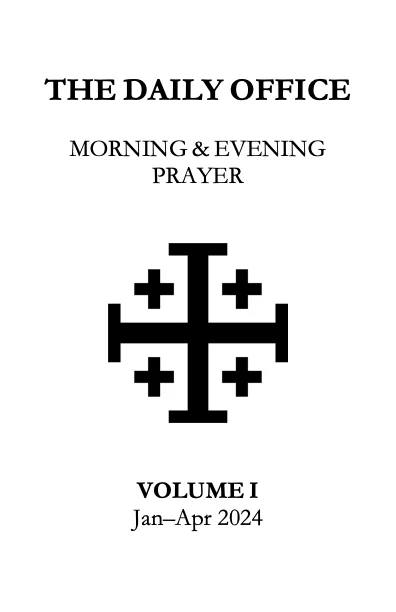
(For a print-at-home Daily Office Booklet that follows the ACNA’s liturgy and lectionary, go here.)
If you’re using the 2019 BCP, you’ll use pages 11-88 and 734-763 the most often. These include the daily prayer services (“Daily Office”) and the Scripture readings assigned for each day (“Daily Office Lectionary”). Daily Morning Prayer (pp. 11-31) and Daily Evening Prayer (pp. 41-56) are the best places to start. However, there are also:
- Midday Prayer (see page 33),
- Compline (for right before bed, see page 57), and
- Family Prayer (shorter services for families with children, see page 67).
If you’d like to read through all 150 psalms every month, use the one-month psalm cycle on page 735. Or, you can simply pay attention to the headings included in the Psalter itself (“Day 1: Morning Prayer” on page 270, “Day 1: Evening Prayer on page 274).
Use the Occasional Prayers and Thanksgivings as a resource.
It’s also worth knowing about the “Occasional Prayers” section (pp. 642-683). You’ll find a helpful list of the 125 different prayers included on pages 642-645. You can use these prayers and thanksgivings whenever you like, whether in a liturgical service or not!
The Holy Eucharist
We’ve already introduced you to the sections of the 2019 BCP that you’ll use most often on your own or with family/friends. The next most important section is undoubtedly “The Holy Eucharist” (pp. 104-158), used for services of Holy Communion.
Note that there are two Communion liturgies included:
- the “Anglican Standard Text” (pp. 105-122) and
- the “Renewed Ancient Text” (pp. 123-138).
The Anglican Standard Text:
The Anglican Standard Text “is essentially that of the Holy Communion service of the Book of Common Prayer of 1662 and successor books through 1928, 1929, and 1962” (p. 104).
The Anglican Standard Text is presented in contemporary language and an ordering of elements/sections that matches other modern Prayer Books. However, the 2019 BCP allows for both traditional language and the 1662 ordering of elements/sections. It can also be abbreviated as needed. See the Additional Directions on pages 139-143 for more information.
The Renewed Ancient Text
The Renewed Ancient Text “is drawn from liturgies of the Early Church, reflects the influence of twentieth-century ecumenical consensus, and includes elements of historic Anglican piety” (p. 104). It is also shorter than the Standard text. Again, see the Additional Directions on pages 139-143 for more information on using both Communion liturgies.
There’s much more in the 2019 BCP!
That covers:
- the introductory material,
- the Daily Office,
- the Daily Office Lectionary,
- the New Coverdale Psalter,
- the Collects of the Christian Year,
- Occasional Prayers, and
- the Holy Eucharist.
These are the sections of the 2019 BCP you’ll use most often. And I believe it’s sufficient for a Rookie Anglican Guide! However, there are many more liturgies and resources in the 2019 BCP! Consider the following:
- Baptism and Confirmation (pp. 160-196)
- Pastoral Rites (performed by a Priest/Pastor)
- Holy Matrimony (pp. 198-214)
- Thanksgiving for the Birth or Adoption of a Child (pp. 215-221)
- The Rites of Healing
- Reconciliation of Penitents (pp. 223-224)
- Ministry to the Sick (pp. 225-226)
- Communion of the Sick (pp. 227-231)
- Additional Prayers for the Sick (pp. 231-235)
- Ministry to the Dying (pp. 236-242)
- Prayers for a Vigil (pp. 243-245)
- Burial of the Dead (pp. 246-266)
- Episcopal Services (performed by a Bishop)
- The Ordinal (for ordaining Deacons and Priests, and ordaining and consecrating Bishops, pp. 470-512)
- Institution of a Rector (pp. 513-522)
- Consecration and Dedication of a Place of Worship (pp. 523-540)
- Special Liturgies of Lent and Holy Week
- Ash Wednesday (pp. 542-552)
- Palm Sunday (pp. 553-558)
- Maundy Thursday (pp. 559-563)
- Good Friday (pp. 564-577)
- Holy Saturday (pp. 578-580)
- Great Vigil of Easter (pp. 581-595)
- Calendars and Lectionaries
- Calendar of the Christian Year (excellent overview, pp. 687-690)
- Calendar of the Holy Days and Commemorations (pp. 691-712)
- Tables for Finding the Date of Easter (pp. 713-715)
- Sunday, Holy Day, and Commemoration Lectionary (used for the readings at Holy Communion, on a 3-year cycle, pp. 716-733)
- Documentary Foundations
- Fundamental Declarations of the Province (pp. 766-767)
- Concerning the Nicene Creed (p. 768)
- Athanasian Creed (pp. 769-771)
- Thirty-Nine Articles of Religion (pp. 772-790)
- Jerusalem Declaration (pp. 791-793)
- Preface of the Book of Common Prayer 1549 (pp. 794-797)
- Preface of the Book of Common Prayer 1662 (pp. 798-802)
Image: Photo by Jacob Davis.


How to Do Morning Prayer in the ACNA’s 2019 Book of Common Prayer
Where Do I Start? Whether you’re a Rookie Anglican or just “Angli-curious,” perhaps you’ve heard of this new Book of Common Prayer 2019 (BCP 2019) and are asking yourself, “What is this thing?” or “How do I use it?” Learning how to use the BCP is a little like learning to drive a car. It…

The Standard of Prayer Book Worship (Jerusalem Declaration 6)
We rejoice in our Anglican sacramental and liturgical heritage as an expression of the gospel, and we uphold the 1662 Book of Common Prayer as a true and authoritative standard of worship and prayer, to be translated and locally adapted for each culture.