

We Believe: One Baptism for the Forgiveness of Sins
The Nicene Creed teaches not only who God is but also what God has done for his people. After confessing that the church is “one, holy, catholic, and apostolic,” we then say, “and we acknowledge one baptism for the forgiveness of sins.” This part of the creed—“one baptism for the forgiveness”—can’t be separated from everything else in the creed. In some ways, it’s further commentary on the Holy Spirit, the Lord and giver of life. The Spirit creates the Church at Pentecost, giving new life to the one body of Christ, forgiving sins.
In other words, in acknowledging “one baptism for the forgiveness of sins,” we don’t mean that we believe in baptism itself. We believe in one God, the Father Almighty, in Jesus Christ his only Son our Lord, and the Holy Spirit the Lord and Giver of Life. Our confession about baptism and forgiveness is part of the confession of the triune Lord. Therefore, what does this mean? What’s at stake in acknowledging “one baptism for the forgiveness of sins”?

Sponsored
Baptism: Repentance and Rebirth
In the broader Christian tradition, baptism has two distinct but overlapping meanings: repentance and rebirth. First, baptism is about repentance. John the Baptist came to prepare the way for the coming Messiah, and he preached a baptism of repentance,
to give knowledge of salvation to [God’s] people in the forgiveness of their sins.
Luke 1:77
That one brief sentence tightly links knowledge and action. Repentance is about living differently: if you have two cloaks, give one away. If you have extra food, share it. But it also means true knowledge of God—or as John calls it, “knowledge of salvation.” Knowledge of salvation means knowing God truly as one’s own God. It means trusting, following, and wholly devoting oneself to God in all areas of life.
Baptism is also a rebirth. It is our entrance into the Christian family. Baptism involves a purification not just of old habits but of an old life. Baptism is so momentous that the Bible speaks of it as a death and resurrection. The old version of us dies, and a new creature arises. This new life is different: it’s somehow more alive than the old life was, because the Holy Spirit animates it. We receive the Spirit by becoming “in Christ” through baptism (1 Corinthians 12:13).
The Weight—and Wait—of Baptismal Glory
Given the powerful significance of baptism in the early Church, early Christians made concerted efforts to thoroughly prepare people for it. They developed a robust process of catechesis to help new members understand the God they were joining and what it meant to live a life wholly shaped by following Christ.
No one thought you needed to know everything there is to know about God before becoming baptized. If that were the case, no one would ever undergo baptism. However, if baptism is what Christians claim it is, then people ought to approach it with a sense of reverence, humility, and preparation. Around the year 200, the theologian Tertullian of Carthage made a strong case for why Christians should wait for baptism until well catechized:
So let them come, when they are growing up, when they are learning, when they are being taught what they are coming to: let them be made Christians when they have become competent to know Christ…
All who understand what a burden (pondus) baptism is will have more fear of obtaining it than of its postponement. Faith unimpaired does not doubt its salvation.
Tertullian, On Baptism, 18
Catechesis, as a preparation for baptism, emerged out of a deep reflection on the weight of glory conferred in baptism. This practice, in turn, grew from patiently attending to Christ’s charge to his disciples,
Go and make disciples of all nations, baptizing them in the name of the Father, Son, and Holy Spirit and teaching them to obey all that he’s commanded.
Matthew 28:19
One Baptism
However, why only one baptism? One of the crises in the early Church was directly about baptism. More specifically, it was about the legitimacy of baptism. When Christians faced persecution in the early Church, many bravely witnessed to the faith—they became “martyrs” (the Greek word simply means “witness”). Others did not. They handed over the faith. In Latin, they were called traditores, those who “handed over” the faith.
The issue wasn’t just about individual traditores. It was also about those people that the traditores had baptized. If the bishop who baptized me abandoned the faith, is my baptism invalid? Some took a hardline position on this question. Baptized by a traditor? Your baptism’s no good. You’ll have to do it again—and make sure it’s with one of the “right” bishops. Others took a more lenient approach, that if the traditor repents, that’s permissible. No rebaptism necessary.
There were issues with both approaches. The laxists undermined the cost of discipleship. The rigorists undermined the power of God working through baptism. The Church ultimately took a middle-way approach. If you were baptized in the name of the Father, Son, and Holy Spirit, you don’t need to be rebaptized. At the same time, one shouldn’t take this as an occasion for sin. There is one baptism for the forgiveness of sins, just as there is:
…one Lord, one faith… one God and Father of all, who is over all and through all and in all.
Ephesians 4:5-6
Forgiveness of Sins
If there’s just one baptism, what do we mean by “forgiveness of sins”? A sin is anything that keeps us away from God—anything that misses the mark, comes up short, harms our neighbor, or otherwise undoes the good work of God in creation and redemption.
Romans 3:23
…for all have sinned and fall short of the glory of God…
Our first parents sinned through disobeying God, and we all have been joined to their sin simply through being born “in Adam.” We were there, in a sense, and we all share in Adam’s sin. This is often referred to as “original sin.” We didn’t just pick up sin from bad habits or imitating others. Sin goes deeper. We are in a state of sin when we are “in Adam.”
When we’re baptized, we receive what Scripture calls “the forgiveness of sins.” This is what Peter preaches at Pentecost:
“Repent and be baptized every one of you in the name of Jesus Christ for the forgiveness of your sins, and you will receive the gift of the Holy Spirit.”
Acts 2:38
In baptism, we go from being “in Adam” to being “in Christ.” As a result, we receive all the blessings Christ has to offer. Most importantly, we get God as Father. Christ shares his sonship with us, his very own being with God. When we receive the Holy Spirit in baptism, we can call God “Father,” just like Christ does. In baptism, everything that keeps us far from God is gone.
Living Repentance
Of course, we all still go on sinning after baptism. Does this change our baptismal status; not at all! Sometimes theologians differentiate between sin and sins. Sins are actions we commit every day that miss the mark and keep us from God. Sin is the fundamental condition of being in Adam. Receiving the one baptism for the forgiveness of sin frees us from sin—from being in Adam and estranged from God.
It doesn’t mean we won’t sin ever again. It does mean that we are no longer “in Adam.” We are no longer enslaved to Satan. Hence, we are free from the tyrannous grip of sin. We live in the forgiveness of sins; as baptized Christians, when we continue to sin, we continue to ask forgiveness.
Continuous Repentance
In the Book of Common Prayer, we confess our sins at Morning and Evening Prayer and anytime Eucharist is celebrated. This shows the reality of ongoing sins. We continue to sin against God “in thought, word, and deed, by what we have done, and by what we have left undone.” That pretty much covers everything!
All the same, the “one baptism for the forgiveness of sins” still holds. Those sins that we commit don’t change our baptized status any more than the prodigal son who demands his father’s inheritance only to run off and squander it. In other words, although we’re baptized only once, we live the baptized life every day. The shape of repentance that marks our entry into the church is also what gives concrete shape to our lives from here unto eternity. This is just what it means for the Church to be one, holy, catholic, and apostolic. This is what it means to believe in the Holy Spirit, who is the Lord and giver of life.
In our confession of one baptism for the forgiveness of sins, we confess something true about ourselves, and in the same breath confess what is most true about God: that he is the God who loves us and gave up his life for our sakes, to draw us into his family through forgiving our sins and making us one with the Father in his Beloved Son. That is excellent news.
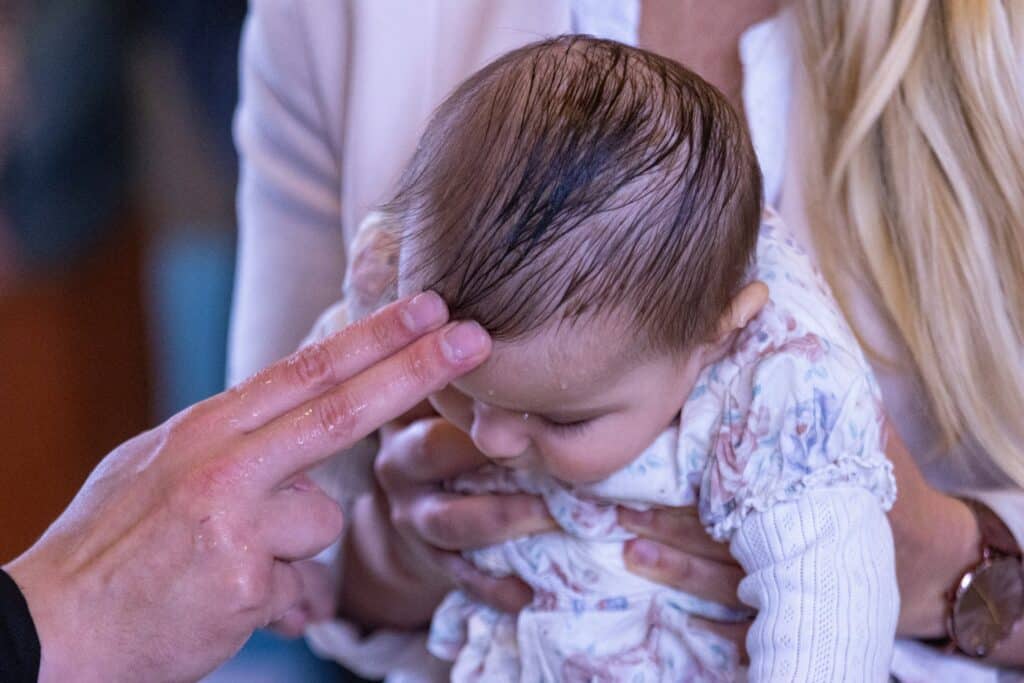
Photo by BlueHorse_pl from Getty Images, courtesy of Canva.

What do Anglicans Believe about Holy Baptism?
All Christians, not just Anglicans, should trust their baptism. If they believe that Baptism is something God does in and for us, not something we do. And that is exactly how the early Church and the Reformers saw this sacrament! God brings people to the water of baptism. He sends his Holy Spirit into their…

Holy Baptism: A Rookie Anglican Guide
The baptized receive regeneration, the forgiveness of sins, and adoption as children of God and members of the covenant. Both infants and adults, upon being baptized, are made members of the Covenant of Grace.
